
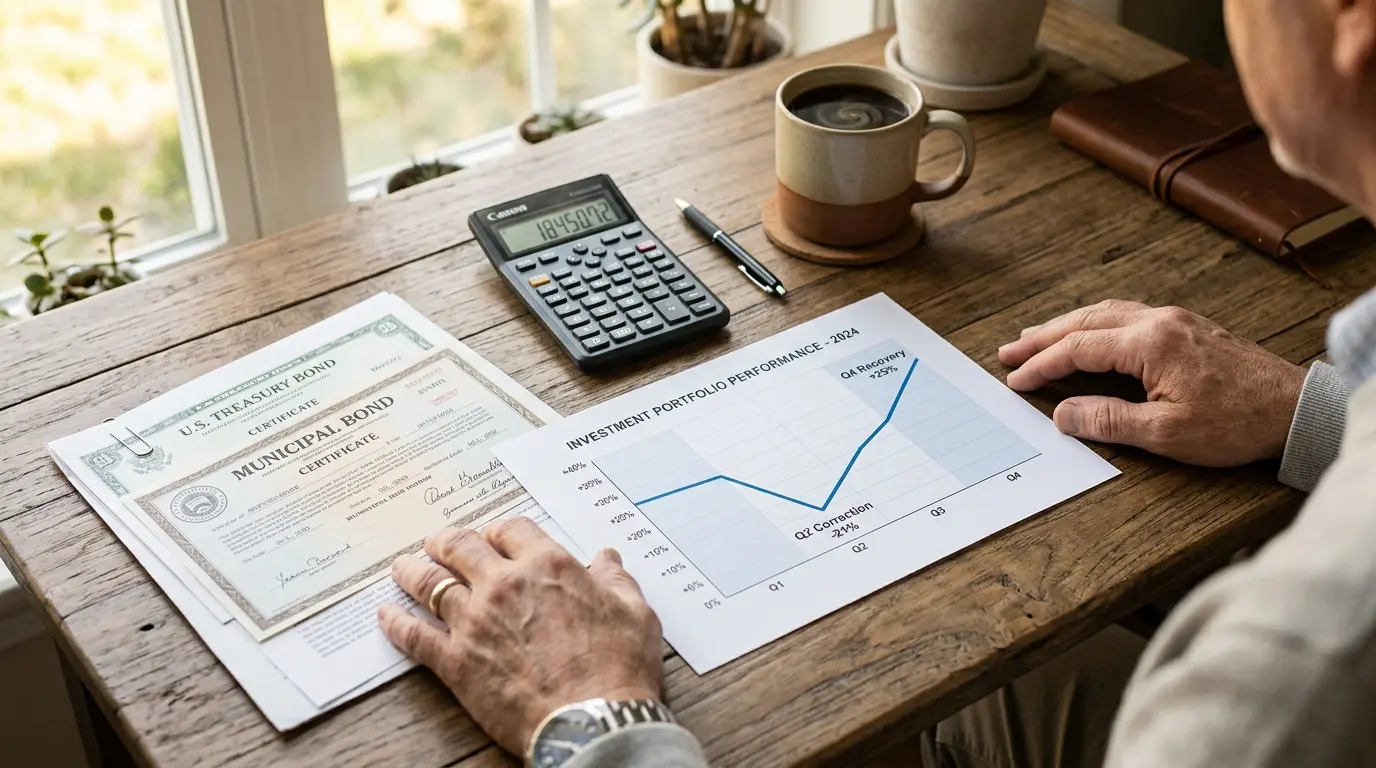
Image generated with AI assistance for educational purposes only.
Why Did My Bond Fund Lose Value When Yields Rose?
Headlines describing a "bond sell-off" can make it sound like something has gone wrong with bonds as an asset class. What is actually happening is more mechanical than that. When prevailing yields rise, bonds issued at lower rates become less attractive at their original price, so their market value adjusts downward until their yield lines up with what is currently available. A bond fund holds a basket of these bonds and is priced daily based on their combined market value, so a rise in yields can show up immediately as a drop in the fund's net asset value (NAV), even when the decline is not caused by defaults or deterioration in the creditworthiness of the underlying issuers.
That distinction matters. A price decline driven by rising yields is a change in market value, not evidence of default or credit deterioration. It may still feel uncomfortable to see on a statement, and that reaction is understandable, but the reason behind the drop is different from the reason a stock might fall after a disappointing earnings report or a bond might fall because a specific issuer is struggling financially.
Is a Bond Fund Loss the Same as a Loss in an Individual Bond?
Not necessarily, and the difference comes down to structure. An individual bond purchased at par and held to maturity is generally contracted to return its face value at maturity, assuming the issuer makes its required payments, regardless of how its price moves along the way. Someone holding that bond directly can watch its quoted price fall during a rate rise and, if they intend to hold to maturity, largely set that price movement aside.
A bond fund like a total market bond fund does not have a maturity date. It holds many bonds and continually replaces bonds as they mature or leave the underlying index, maintaining exposure to a broad segment of the bond market. There is no single date at which the fund "matures" and returns a fixed value. (Target-maturity bond funds are a separate product type, built to wind down and return proceeds on a defined date closer to how an individual bond behaves, and are not addressed here.) Instead, an investor's return from a fund like this over time is tied to the yield available on whatever it currently holds, plus or minus price changes, not to a promise that today's lower price will return to some specific prior level.
This is the piece that often gets lost in the "just wait it out" framing. Holding to maturity can allow an investor to avoid realizing an interim market-price loss on an individual bond, assuming the issuer makes the required payments. For a fund, the more useful way to think about the future is that its current yield provides an important starting point for expected returns, although actual returns will also depend on changes in interest rates, credit conditions, expenses, and the fund's holdings over time. If yields stay elevated, new purchases, including reinvested income, are being made at that higher current yield, which is one reason continuing to reinvest through a decline is often framed as disciplined rather than simply hopeful, though whether it fits a given investor depends on their goals, time horizon, and IPS.
What Does Reinvesting Interest During a Decline Actually Do?
When a bond fund distributes income and that distribution is reinvested automatically, it buys additional fund shares at whatever the prevailing price is, including a depressed price during a rate-driven decline. This increases the number of shares owned for the same dollar amount of income. If the fund's price later recovers, those additional shares are worth more than the cash that purchased them, and the shares acquired earlier at a higher price also participate in any recovery.
The share-count effect is similar to dollar-cost averaging: the same dollar amount purchases more shares when the fund's price is lower. But reinvesting a distribution is different from deliberately adding new outside cash to the investment. It simply keeps the distribution invested in the fund. It does not guarantee a favorable outcome, because it depends on prices eventually moving back up over the holding period, but the mechanic itself, more shares for the same reinvested dollar, is a real and direct result of continuing to reinvest rather than redirecting or halting distributions during a downturn.
Should I Sell My Bond Fund During a Rate-Driven Downturn?
Whether to hold, sell, or continue reinvesting through a rate-driven downturn depends on the investor's goals, time horizon, liquidity needs, and how that allocation is positioned within their investment policy statement (IPS) or overall financial plan, not on a general rule. Selling after a price decline realizes the decline and removes the fund from participating in future changes in price and income, while continuing to hold and reinvest keeps the fund collecting income at current yields and keeps open the possibility of price appreciation if yields later decline. Which of these is appropriate is an individual determination.
An allocation intended to fund near-term spending carries different considerations than one intended to support growth over a much longer horizon, and whether the investor has an immediate need for that cash is one of several factors to weigh. This is one of the reasons fixed income sizing and duration are typically coordinated with the rest of a retirement glide path and reviewed against the investor's IPS, rather than evaluated as a standalone decision.
How Much Does Duration Affect the Size of the Swing?
Duration is a measure of how sensitive a bond or bond fund's price is to a given change in yields. As a general rule, the longer a fund's duration, the larger its price move for the same change in yields, in either direction. A short-term bond fund will typically show a smaller price decline than a long-term bond fund when yields rise by the same amount, and it will typically show a smaller bounce when yields fall.
This matters in a couple of ways. It explains why two investors holding "bonds" can have very different experiences during the same rate move, depending on what duration they hold. It also means that holding a longer-duration fund through a downturn and holding a shorter-duration fund through the same downturn are not really the same decision; the potential reward and the potential volatility both scale with duration, and that trade-off is one a financial advisor typically weighs against an investor's time horizon and spending needs rather than treating all bond funds as interchangeable.
- Shorter-duration funds: smaller price swings in either direction and generally less sensitivity to changes in interest rates
- Longer-duration funds: larger price swings in either direction and greater sensitivity to changes in interest rates
- Municipal bond funds follow the same price mechanics as taxable bond funds; in a non-retirement (taxable) account, the tax treatment of the income differs, but a rise in yields affects NAV the same way
Why Can't I Count on Yields Coming Back Down on a Particular Schedule?
Interest rate cycles have moved both up and down at various points in history, but historical patterns do not indicate how or when rates will move going forward. It cannot be known in advance whether or when yields might decline, or how far rates might move in either direction before that happens. Rates could decline within a relatively short period, remain elevated for an extended stretch, or settle into a range that differs meaningfully from where they were before the most recent rise.
Because of that uncertainty, the more durable part of the reasoning is not "yields will definitely come back down soon." As older bonds mature or are replaced, a bond fund can reinvest at prevailing yields. When prevailing yields are higher than the yields on bonds being replaced, this can increase the income generated by the portfolio over time. That ongoing income is part of a bond fund's total return whether or not prices ever fully recover to a previous level.
The Bottom Line
A bond fund's price decline during a rate rise is a real change in market value, but it reflects how the fund's underlying holdings are priced, not a default or a permanent loss of principal the way those terms apply to an individual security. Reinvesting distributions through that kind of decline does increase the number of shares owned at a lower price, and that can work in an investor's favor if prices later recover, though no specific recovery timeline can be promised.
The decision of whether to hold through a downturn, and how much duration risk to carry in the first place, depends on an investor's time horizon, spending needs, and how that fixed income allocation fits into the broader plan. These are the kinds of interdependent variables that a financial plan can help an investor evaluate together: duration, time horizon, spending needs, tax considerations, and the role of fixed income within the broader portfolio.
Deeper Dives: Related Topics
For related strategies beyond bond fund mechanics, explore:
→ Related strategyFixed Income in Retirement → → Related strategyBuilding a Bond Ladder Strategy → → Related seriesSequence of Returns Risk and Glide Path Strategy →