
The Two Roth Conversion Mistakes
A Roth conversion can be a useful tax-planning strategy for some households. But it is also easy to execute poorly.
A lot of retirees make one of two mistakes:
- The under-conversion mistake: They do nothing and wait until Required Minimum Distributions (RMDs) begin. At that point, they must begin taking minimum distributions from their tax-deferred accounts. Substantial account balances result in substantial distributions, which can increase taxable income and, depending on their other income and deductions, may push some of their income into higher tax brackets, potentially resulting in materially higher lifetime taxes.
- The over-conversion mistake: They overreact to the under-conversion risk and convert so much of their traditional IRA during early retirement that they pay excessive tax upfront. This results in more tax being paid than the strategy saves them over their lifetime.
The right path lies between these extremes. It requires understanding how conversions affect your lifetime tax bill, plus monitoring your strategy annually.
Mistake 1: Under-Converting (The Cost of Inaction)
The Problem
A lot of retirees retire with the majority of their retirement savings in pre-tax vehicles like traditional IRAs and 401(k)s. They assume they will deal with taxes when they need the money. This leads them to do nothing about conversions during their low-income years.
Then, when Required Minimum Distributions (RMDs) begin, they are forced to withdraw a percentage of their traditional IRA balance every year, regardless of whether they need the money.
The math gets ugly fast.
A Hypothetical Example: David & Patricia Chen
Hypothetical illustration: David and Patricia are fictional clients created solely to illustrate how Roth conversion decisions can affect projected taxes and portfolio values. The results shown are hypothetical and depend on the assumptions used in the analysis, including income, account balances, investment returns, spending, tax rates, inflation, Social Security, Medicare premiums and longevity. Actual results will vary, and there is no guarantee that any particular Roth conversion strategy will produce the results shown.
David and Patricia Chen are looking to retire. Here is their situation:
Current balances:
Income projection without conversions:
When their financial advisor models their retirement income from today through age 95, here is what they see:
David & Patricia's Projected Tax Brackets
| Age Range | Tax Bracket | Reason |
|---|---|---|
| 60–65 (working) | 22% | Still employed |
| 66–73 (early retirement) | 10% | Living on savings, not yet RMDs |
| 75–95 (RMD years) | 24–35% | RMDs force large distributions |
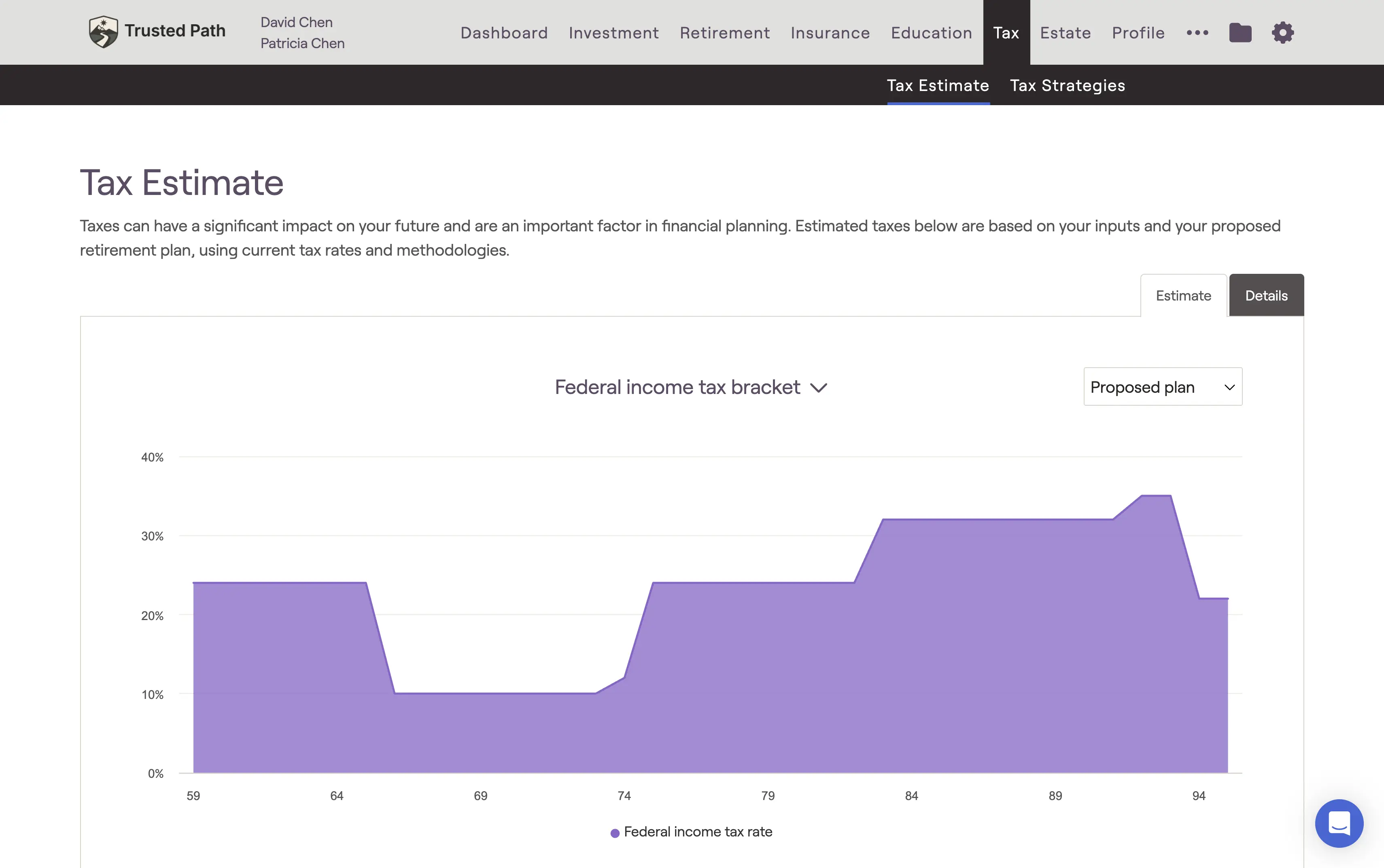
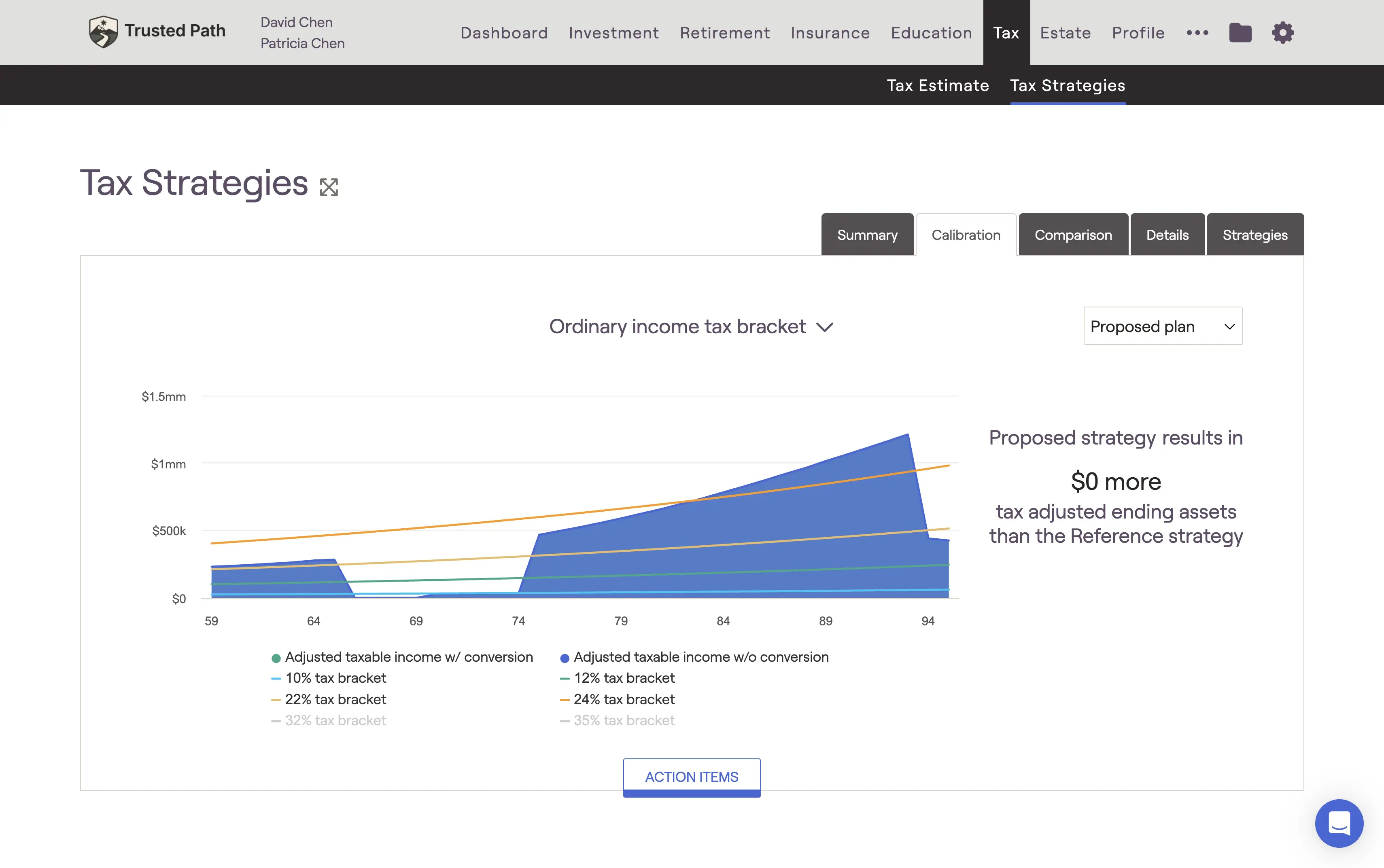
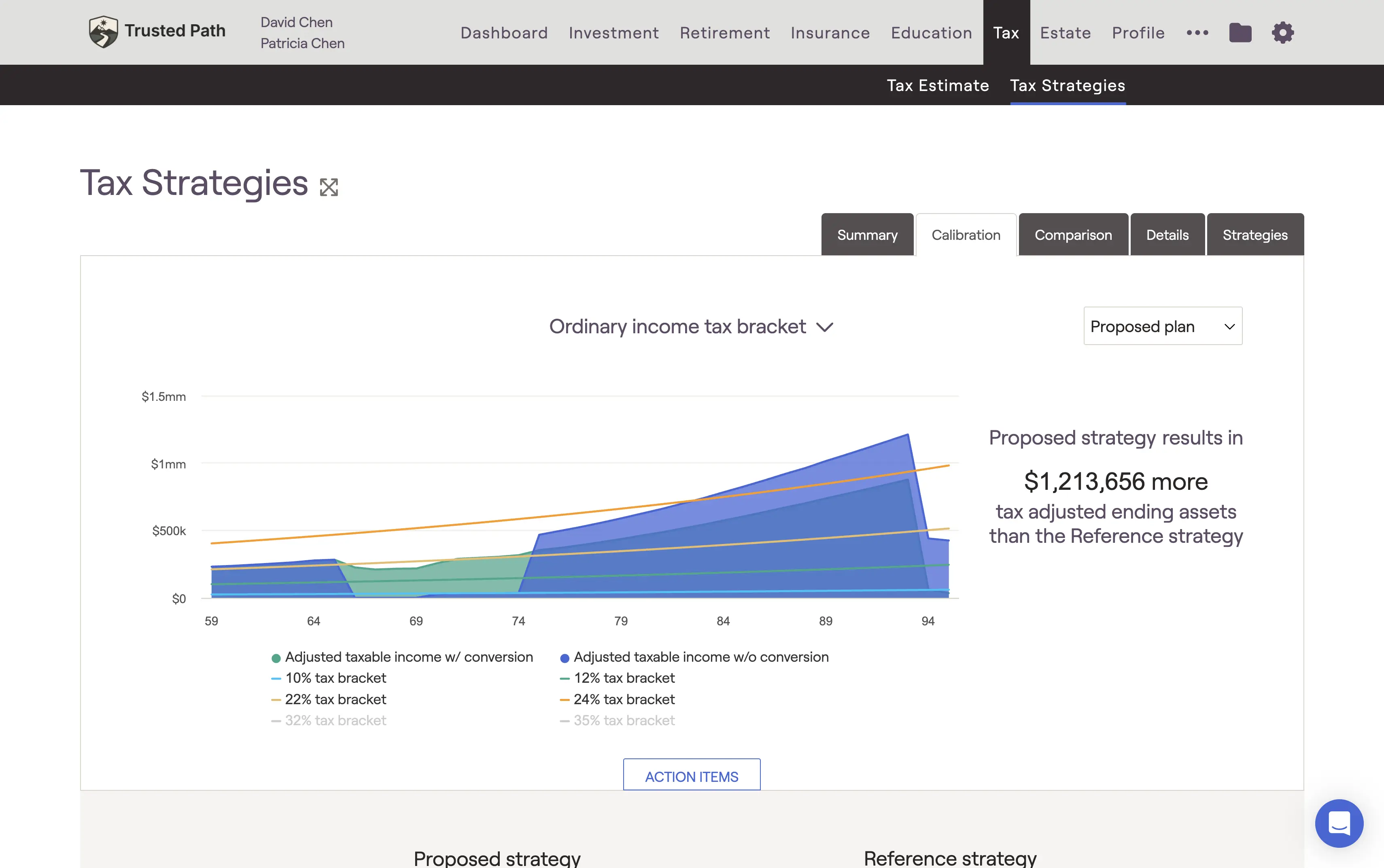
The issue: David and Patricia Chen enter retirement with a short window of low income before RMDs begin. Their substantial traditional account balances will result in substantial RMDs, which can increase their taxable income and, depending on their other income and deductions, may result in higher tax brackets for many years after.
If they do nothing, they will pay:
- Low tax during the low-income years
- High tax during the high-income years (Social Security and RMD years)
The net effect: they pay more lifetime tax than if they had converted strategically during the low-income window.
The Impact
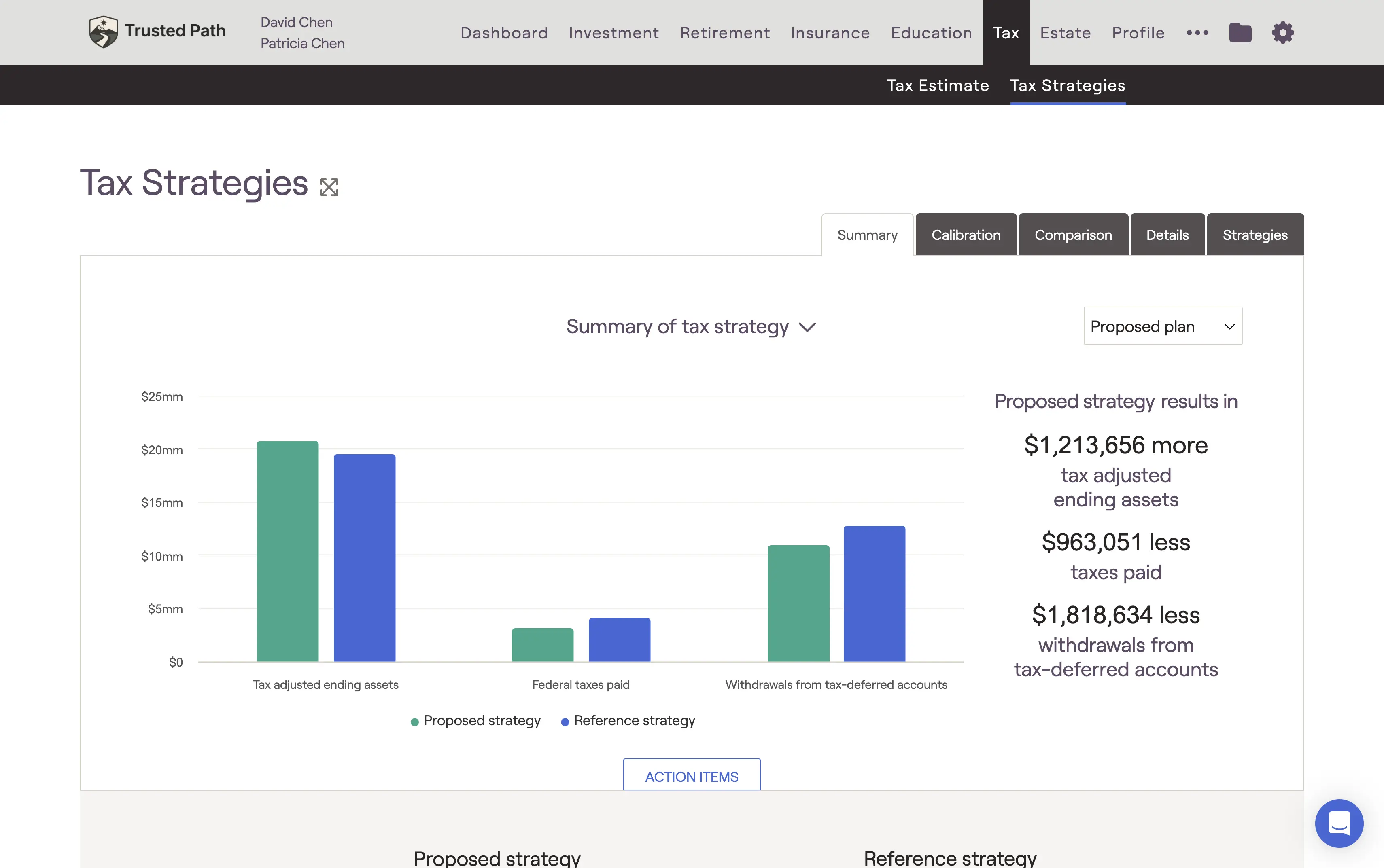
With strategic Roth conversions during their low-income years, I ran multiple scenarios across ordinary income tax brackets, capital gains tax brackets, and Medicare premium tax brackets. After testing all approaches, the strategy that produced the strongest modeled outcome under these assumptions was identified. The analysis projects:
- $1,213,656 more in tax-adjusted ending assets
- $963,051 less in taxes paid over their lifetime
- $1,818,634 less in withdrawals from tax-deferred accounts
The catch: they have to execute the conversions during their low-income years. Once RMDs begin, the opportunity to complete large, tax-efficient conversions may become more limited because RMDs generally must be taken first and add to taxable income.
Mistake 2: Over-Converting (The Cost of Being Overeager)
The Problem
Some retirees, aware of the under-conversion risk, overcorrect. They see the high RMDs coming and decide to convert as much as possible today, trying to move everything into a Roth.
This sounds proactive. In reality, it is often counterproductive.
Why Over-Converting Fails
A Roth conversion is generally added to ordinary taxable income for the year of the conversion. If the taxable portion of a $100,000 conversion falls entirely within a 12% federal marginal tax bracket, the conversion would generate approximately $12,000 in additional federal income tax, before considering state income taxes and other factors.
Here is where the math fails:
Suppose you convert so much that you push yourself into the 22% bracket. Now you are paying $22,000 in tax on the next $100,000 you convert.
If the marginal tax rate on the conversion is similar to the marginal rate you would otherwise expect to pay on those dollars later, the tax advantage of converting may be limited. Other factors, including future tax rates, investment growth, Medicare premiums, state taxes, and the source of the tax payment, can also affect whether a conversion is worthwhile.
The portfolio impact depends on how you pay the tax. If the $22,000 tax bill is paid from the amount being converted, only $78,000 reaches the Roth. If the tax is instead paid with funds held outside the retirement account, the full $100,000 can be converted, but you have still used $22,000 of outside assets to pay the tax. Either way, you have reduced the wealth available to grow, compared to the scenario where you had left it in the traditional account and paid 22% tax on the withdrawal later.
A Hypothetical Example: Over-Converting
Going back to David and Patricia Chen, suppose they look at their projected income at age 85 (in the 32% bracket) and think: "I will convert everything to Roth right now at up to 35% so I never have to pay tax later."
Here is why this logic fails:
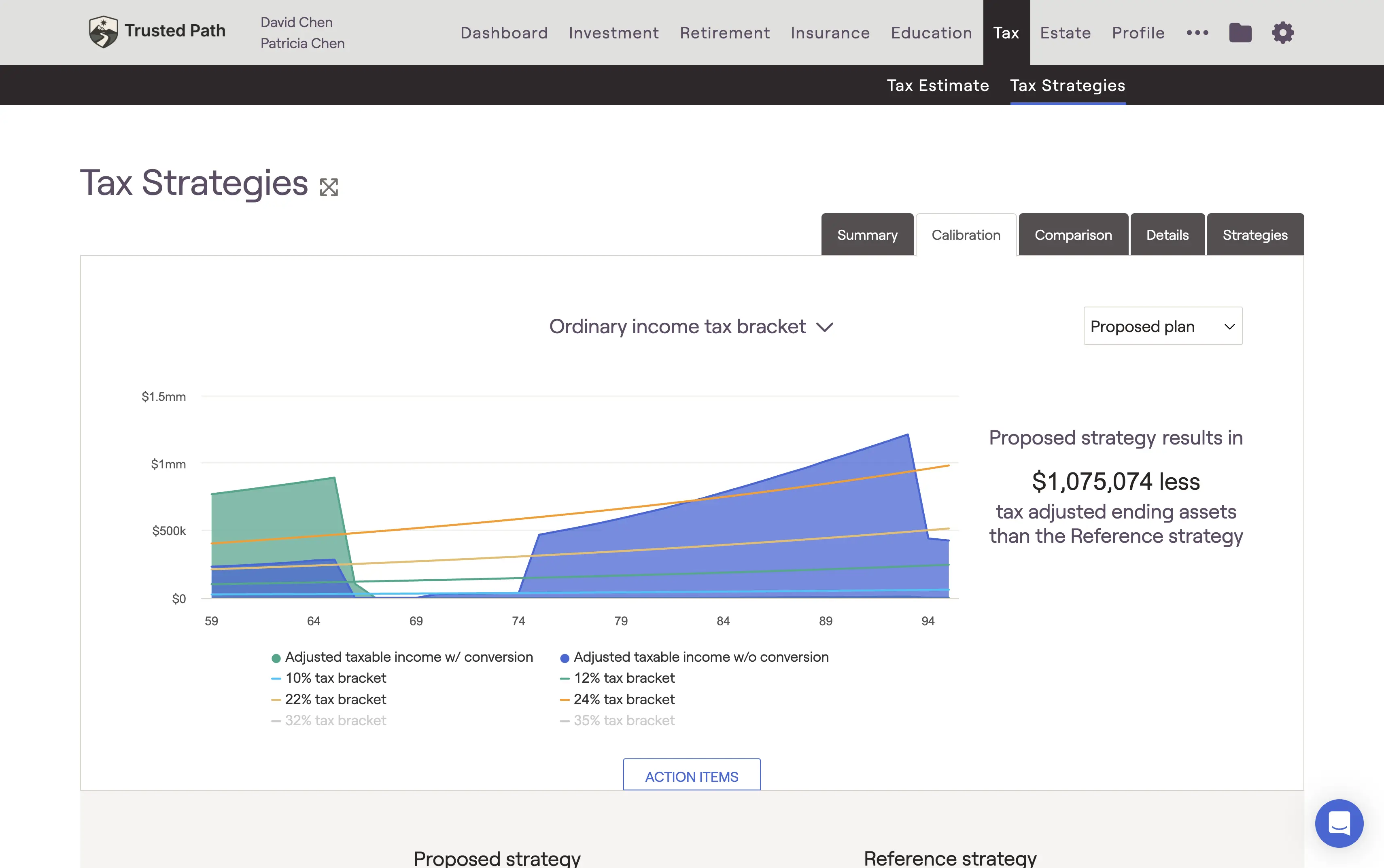
Their flawed assumption is that converting at "up to 35%" today is worth it to avoid the 32% tax later. But the actual blended rate on the conversion turns out to be closer to 22%, not 35%. And the RMD-year tax rate they are trying to avoid? Also 22-24%. There is almost no tax savings.
The actual financial impact of over-converting:
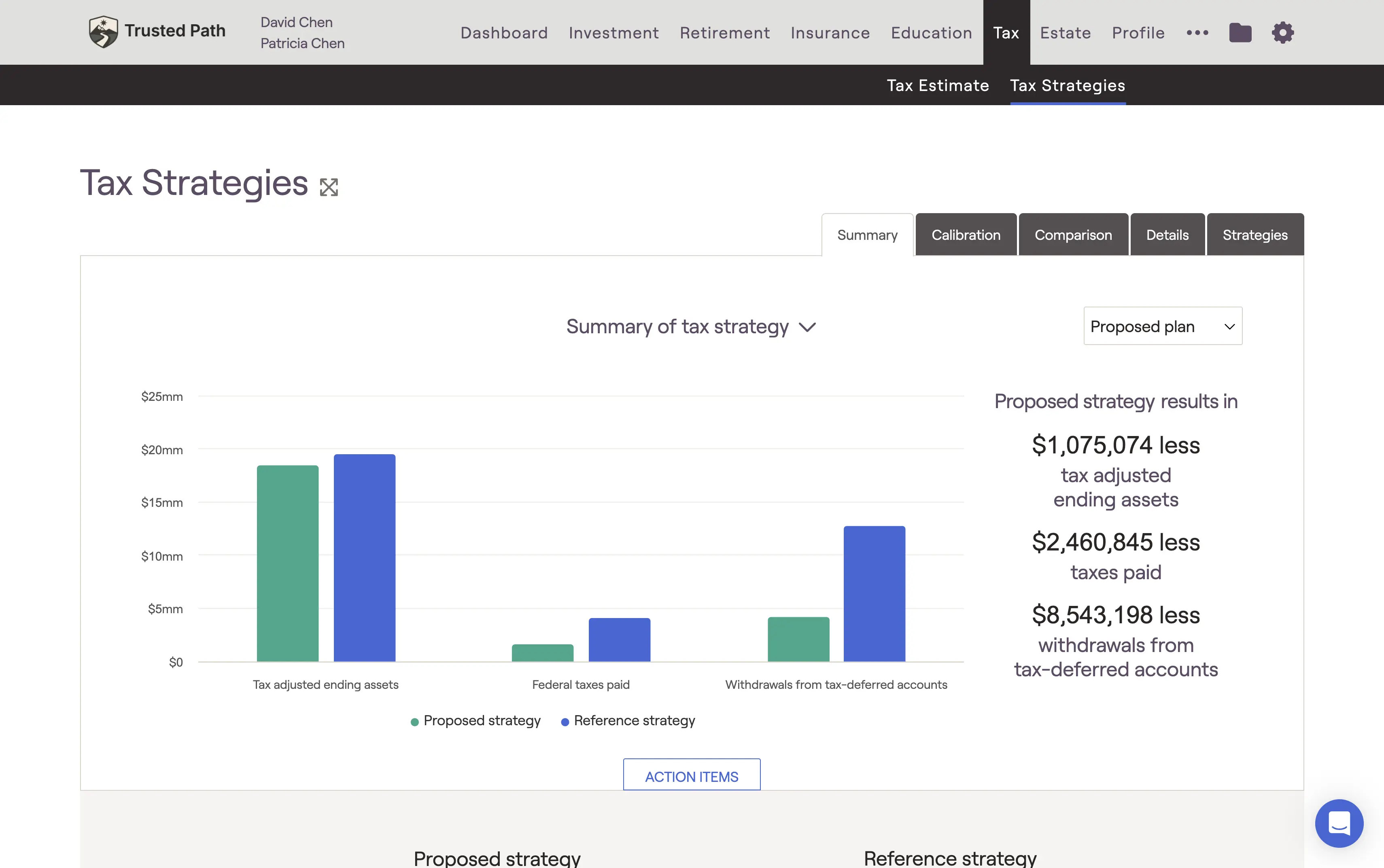
Doing so results in:
- $1,075,074 less in tax-adjusted ending assets
- $2,460,845 less in taxes paid
- $8,543,198 less in withdrawals from tax-deferred accounts
Why this happens: They have reduced their portfolio by the tax cost of the conversion. They did gain a benefit: the converted assets grow tax-free in the Roth. But they have overpaid for that benefit.
In this scenario, by converting too aggressively based on flawed math, they have consumed portfolio value that could have grown during their retirement years, leaving them with significantly fewer assets at the end of their lifetime.
Related Strategies
Roth conversions work best as part of a coordinated retirement income plan:
- Roth Conversions in the 5-10 Year Window Before RMDs The timing and execution of conversions during early retirement, and why the biggest income year is not always the best year to convert. Read →
- IRMAA and the Two-Year Lookback How conversions affect Medicare premiums two years later, and why IRMAA surcharges can dwarf the tax savings from converting. Read →
- Costly Tax Mistakes Retirees Make A broader look at the most expensive retirement tax mistakes:and how to avoid them in your planning. Read →
The Bottom Line
Roth conversions are powerful, but they require discipline and planning. The under-conversion mistake (doing nothing and letting RMDs increase taxable income) can result in materially higher lifetime taxes in some circumstances. The over-conversion mistake (converting too much too fast) can reduce portfolio value by more than any tax savings justify.
A strategic approach is to convert systematically during your low-income years (before RMDs begin), filling your tax brackets methodically, and monitoring your strategy annually. This approach smooths your taxable income over time and can potentially save significant lifetime taxes compared to either extreme.
A lot of retirees never model this strategy, and as a result, they end up paying unnecessarily high lifetime taxes. A multi-year projection that shows your income from today through age 95 (or beyond) can reveal the true cost of inaction and help identify a conversion approach suited to your specific situation.
Assumptions and Inputs: David & Patricia Chen Analysis
The hypothetical results shown for David and Patricia Chen depend on the following assumptions and inputs. Actual results will vary based on different assumptions, market performance, and individual circumstances.
| Assumption | Value |
|---|---|
| Projection Horizon | Age 66 through age 95 |
| Retirement Ages | David: 66, Patricia: 66 |
| Current Annual Salary Income | $310,000 (through age 66) |
| Annual Retirement Expenses | $10,000/month ($120,000/year) |
| Social Security Claiming Age | Age 70 (both spouses) |
| Asset Allocation | 60% equities / 40% fixed income |
| Expected Annual Portfolio Return | 6.1% (blended) |
| Portfolio Standard Deviation | 9.8% |
| Inflation Assumption | Spending adjusted for inflation annually |
| Starting Net Worth | $3,500,000 |
| Tax-Deferred Assets | $2,900,000 |
| Taxable Assets | $450,000 |
| Tax-Free Assets | $100,000 |
| Effective Federal Tax Rate (Current) | 15.7% |
| Analysis Method | Monte Carlo simulation (1,000 separate trials) |
| Federal Income Tax Rates | 2026 tax brackets |
| State Income Tax | California rates (up to 13.3%) |
| Longevity Assumption | Planning through age 95 and beyond |
Key drivers of the outcome include the assumed portfolio returns, inflation rate, withdrawal timing, Social Security claiming age, and the specific tax brackets and rates in effect during the projection period. Changes to any of these assumptions would produce different results. This analysis does not include advisor fees, investment fees, or account fees, which would reduce returns and affect the outcome.