
Image generated with AI assistance.
The moment you leave work, a common thought emerges: "Now is the time to do a big Roth conversion. My income is lowest, I can pay the taxes from my savings, and I may reduce those massive RMDs looming at age 73 or 75 (depending on my birth year)."
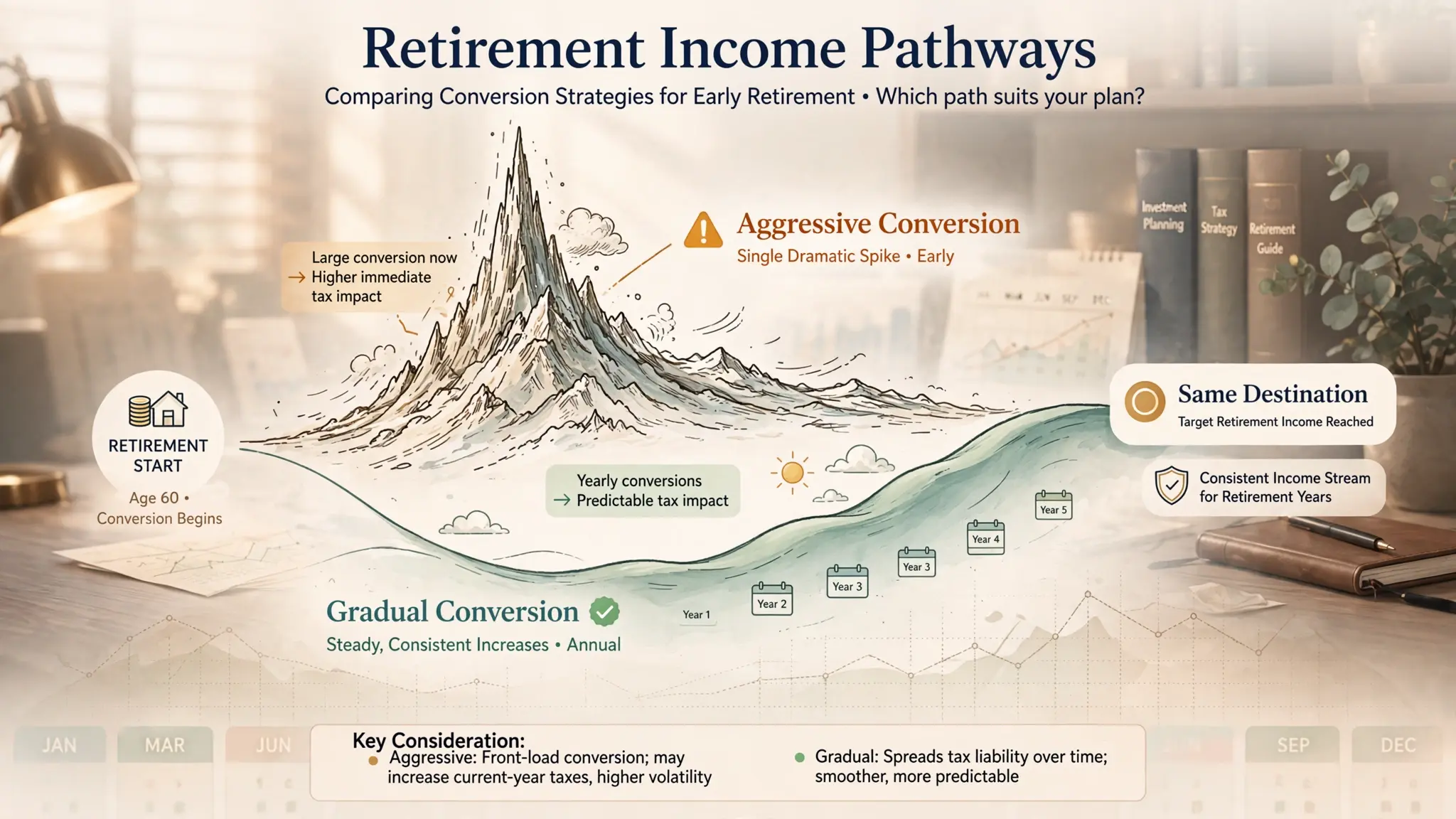
This instinct makes intuitive sense. But there is an important tax-rate misconception that can make a large first-year conversion more expensive than expected: aggressive conversion in year one may push you into a tax bracket that's higher than the future RMD bracket you were trying to avoid.
In some situations, spreading conversions across multiple years may produce a better after-tax result than making a very large conversion in the first year. Each conversion may be sized strategically to stay within a target tax bracket.
This post explains the bracket trap, and what a better approach may look like.
The Bracket Trap: Why Aggressive Conversion May Backfire
The intuition seems sound: retire early, your taxable income falls, and you may have an opportunity to convert some traditional retirement assets to a Roth IRA while using lower tax brackets.
But there is an important tax-rate misconception: a Roth conversion is not necessarily taxed entirely at your current marginal tax rate. The taxable portion of the conversion is generally included in your income for the year, and the conversion itself can push additional income into higher tax brackets.
For example, if you begin the year with relatively little taxable income and make a very large Roth conversion, the first dollars of the conversion may fill the lower tax brackets. Additional dollars can then fall into the 24%, 32%, 35%, or even 37% federal brackets, depending on your filing status and total taxable income.
This does not mean the entire conversion is taxed at the highest bracket you reach. Federal income tax brackets are marginal, so only the portion of taxable income within each bracket is taxed at that bracket's rate.
The planning issue is therefore not simply "convert while your current rate is low." The more important question is: How much should you convert before the marginal tax cost of the next dollar becomes unattractive?
That is why Roth conversion planning often involves modeling different conversion amounts rather than automatically converting as much as possible. A smaller conversion may keep more of the conversion within lower tax brackets, while a larger conversion may provide more future tax-free Roth assets but come with a higher current marginal tax cost. Other factors, such as state income taxes, Medicare IRMAA, future tax rates, charitable giving, and the taxpayer's expected future income, can also affect the analysis.
Projection-Based Conversion Planning: A Framework
What the math actually shows: the right Roth conversion strategy is not a one-size-fits-all approach. Instead, it flows from a systematic projection across your full planning window.
The projection framework:
Ideally, start by projecting your tax situation across your entire plan: from now through your expected lifespan based on your life expectancy. Your projection might include various factors particular to your situation, such as these:
- Expected ordinary income tax brackets each year, based on your income sources (employment, business, rental income, investment income, Social Security, and other taxable income)
- Expected capital gains tax brackets each year, considering your current investment income and whether your LTCG rate will change due to income thresholds
- Expected IRMAA income thresholds and Medicare premium surcharges each year, recognizing the two-year lag between your MAGI and your premium tiers
- Expected RMD amounts and how they interact with other income sources
- Expected Social Security claiming age: ideally, run scenarios across different claiming ages to figure out your optimal Social Security claiming strategy and how it affects your overall financial picture, provisional income, and MAGI
- ACA subsidy loss if you are retiring before Medicare-eligible age (65 as of 2026): For people purchasing coverage through the ACA Marketplace, Roth conversions can increase household income used to determine Premium Tax Credit eligibility. Beginning in 2026, households generally lose federal Premium Tax Credit eligibility when household income exceeds 400% of the federal poverty line. This "subsidy cliff" can be significant and should be factored into conversion scenarios
- Terminal tax rate on wealth transfer if you plan to pass wealth to heirs tax-efficiently: Roth assets can provide significant income-tax advantages to heirs because qualified distributions are generally tax-free. However, beneficiaries are still subject to inherited Roth IRA distribution rules, including the applicable 10-year rule and, in some cases, the Roth five-year rule. Taxable investments may receive a basis adjustment at death, potentially eliminating some or all of the unrealized capital gain, but traditional IRA assets generate ordinary income tax for beneficiary distributions. Understanding your heirs' tax brackets and estate tax exposure helps you decide whether converting now (and paying tax at your rate) is better than leaving traditional assets for them to inherit
Once you have this picture, you then develop multiple conversion scenarios tailored to your unique situation. These scenarios should reflect different conversion patterns that fit within your constraints:
- Your available after-tax cash to pay conversion taxes
- Your target tax bracket for each year
- Years when you face IRMAA tier transitions (and whether you want to avoid them)
- Years when ACA subsidy cliffs occur (if you're pre-Medicare)
- Your Social Security claiming age and when RMDs begin
- Your estate planning goals
Common patterns might include aggressive early conversion, steady conversions across all years, or a hybrid approach. But the specific scenarios you test should emerge from YOUR projection, not from a generic list.
For each scenario you develop, calculate the total projected economic cost across the planning period, including federal and state income taxes, capital gains taxes, IRMAA surcharges, ACA Premium Tax Credit reductions or losses, and other relevant costs. Compare the after-tax results.
For California residents, state income taxes are a material component of the analysis. California generally taxes Roth conversions as ordinary income, subject to California-specific rules and differences from federal treatment. Because California's highest marginal rate exceeds 13%, the state tax impact on conversion decisions can be as significant as the federal analysis.
This comparison may help inform your conversion strategy. The scenario with the most favorable tax outcome could be a starting point for your decision, though your actual choice may also reflect other considerations beyond tax efficiency (cash flow constraints, family goals, estate planning, or other factors unique to your situation).
Critical caveats:
Keep in mind that your projections rest on assumptions:
- Expected rate of return may differ from actual returns. Market volatility and sequence-of-returns risk are real. A poor market year early in your retirement could change the optimal strategy.
- Expected tax brackets may change due to legislative action. Tax law is not static.
- Expected income sources may shift (unexpected inheritance, continued consulting income, pension payments starting earlier or later than planned).
For this reason, the key to success is to re-run your projections regularly: annually, or whenever a major change occurs (job loss, inheritance, law change). Each time you project, you may find a new optimal path, and you should adjust your conversion strategy accordingly.
The goal is not to lock in a perfect ten-year plan in year one. The goal is to make informed decisions right now based on what you know today, and then adapt as reality unfolds and your circumstances change.
When Aggressive Early Conversion Still Makes Sense
This post argues against the "biggest year first" strategy in most cases. But there are scenarios where aggressive early conversion is the right call:
- You have substantial taxable assets and low W-2 income expectations (you may truly stay in a low tax bracket)
- Your future RMD may be large because your IRA balance is substantial, and you want to reduce it materially before RMD age
- You're charitably inclined and plan to make qualified charitable distributions (QCDs) later, which may satisfy part or all of your RMD while reducing the amount included in taxable income
- You expect tax rates to rise materially, and locking in current rates is worth the IRMAA cost
- You don't care about Medicare premiums because you have plenty of income for other expenses anyway
But these are situations where a larger early conversion may be worth considering. The appropriate conversion pattern depends on the taxpayer's projected tax rates, cash flow, Medicare costs, health insurance costs, and other circumstances.
The Personalized Piece
Your optimal conversion strategy depends on variables that are unique to you:
- Your specific IRA balance and account distribution (traditional vs. after-tax basis)
- Your Social Security start date and amount
- Your access to taxable cash (and whether you'd need to use RMD cash or conversion proceeds to pay taxes)
- Whether you plan charitable giving and QCDs
- Whether you expect large one-time income (inheritance, business sale, deferred compensation)
- Your health and longevity assumptions
None of these are one-size-fits-all. That's why modeling across multiple years, with professional guidance, tends to yield better outcomes than following general rules of thumb.
If you're thinking about early retirement and wondering about Roth conversions, learn more about our retirement planning process to explore your situation.