
As a fee-only financial advisor in Santa Rosa, California, at Trusted Path Wealth Management, I help individuals and families approach retirement with more clarity and confidence. A thoughtful withdrawal strategy not only supports your lifestyle but can also help you manage your tax exposure throughout retirement.
When most people approach retirement, the biggest question tends to be: “How much can I safely withdraw each year?” But there's another, equally important consideration: “How should I withdraw it?”
Without a tax-efficient strategy, taxes could take a meaningful bite out of your retirement income. Fortunately, by being intentional about the order and source of your withdrawals, you can use tax-efficient strategies to help your savings go further and support your long-term financial goals.
This post outlines several key principles that can help you create a more tax-efficient retirement income strategy.
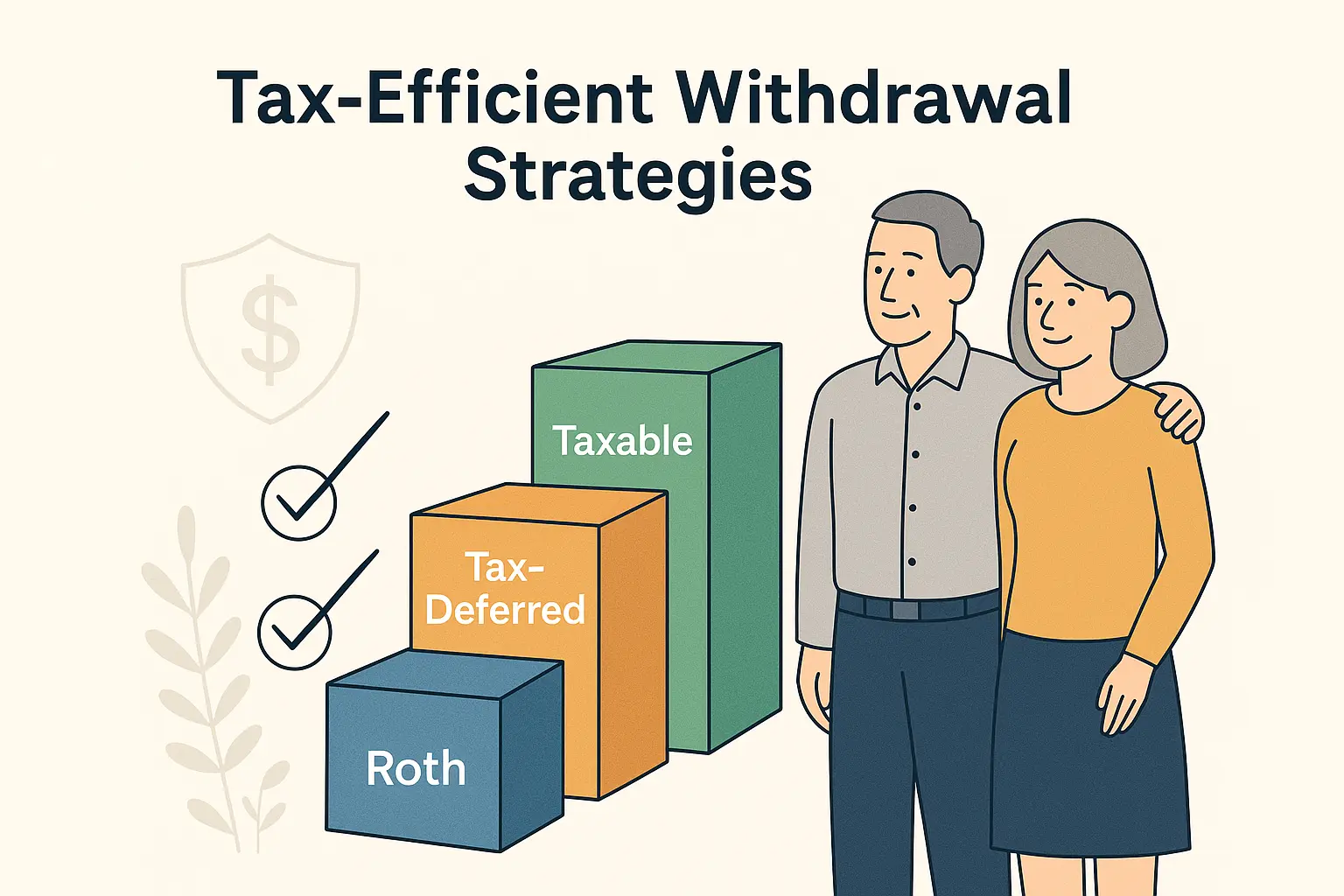
Illustration generated with AI assistance from OpenAI’s ChatGPT.
Know the Account Types for Tax-Efficient Retirement Withdrawals
Understanding how to withdraw from your retirement accounts in a tax-efficient way can significantly impact your retirement income. Let's explore the key account types and their tax implications:
- Social Security Benefits: Understanding the taxation of these benefits is crucial, as up to 85% may be taxable depending on your total income
- Investment Account Strategy: Knowing how each account type is taxed helps optimize your withdrawal sequence
- Withdrawal Timing: Strategic timing of distributions can minimize taxes and maximize benefits
Let's break down the three main types of retirement accounts and their specific tax treatments:
| Account Type | Examples | Tax Treatment |
|---|---|---|
| Tax-Deferred | Traditional IRA, 401(k), 403(b) | Withdrawals are generally taxed as ordinary income when rules are met |
| Tax-Free | Roth IRA, Roth 401(k) | Withdrawals are tax-free if rules are met |
| Taxable | Brokerage, savings, CDs, savings bonds | Interest, dividends, and capital gains taxes |
Tax-Deferred Accounts
These include Traditional IRAs, 401(k)s, 403(b)s, and other similar plans. Contributions are often made pre-tax, reducing your taxable income in the year of contribution. However, withdrawals in retirement are taxed as ordinary income, which could be higher depending on your other income sources at the time.
Key considerations:
- Subject to Required Minimum Distributions (RMDs) starting at age 73.
- Withdrawals increase your Modified Adjusted Gross Income (MAGI) and could trigger higher Medicare premiums or taxation of Social Security benefits.
- Planning early Roth conversions can help reduce the future tax impact.
Tax-Free Accounts
Roth IRAs and Roth 401(k)s offer tax-free withdrawals in retirement, assuming you follow the rules (typically age 59½ and the account has been open at least 5 years). Contributions are made with after-tax dollars, so you don’t get an upfront deduction, but your future withdrawals, including earnings, are generally tax-free.
Key considerations:
- No RMDs for Roth IRAs (though Roth 401(k)s are subject to RMDs unless rolled over to a Roth IRA).
- Valuable for managing tax brackets in retirement, especially in years of high income or large capital gains.
- Ideal asset for leaving to heirs because of tax-free growth and distribution.
Taxable Accounts
These are your brokerage accounts, bank savings, CDs, and savings bonds. There are no tax benefits upfront, but they offer the greatest flexibility. Income generated' interest, dividends, and capital gains is generally taxable in the year earned.
Key considerations:
- Favorable tax treatment for qualified dividends and long-term capital gains.
- Selling appreciated assets in low-income years may allow for capital gain harvesting, potentially paying 0% on gains within certain income thresholds.
- Selling assets with losses can enable tax-loss harvesting, which helps offset capital gains or reduce taxable income.
- You can access your money at any time without penalties or RMDs.
Why it matters: The order in which you tap these accounts can impact how much tax you owe, whether you trigger higher Medicare premiums, and even how much of your Social Security benefits get taxed.
Tax-Efficient Withdrawal Strategy: The Traditional Order and Why It Matters
The conventional advice for tax-efficient withdrawals generally follows this sequence:
- Taxable accounts first
- Tax-deferred accounts next
- Roth accounts last
This approach aims to preserve the tax-advantaged growth in your retirement accounts while minimizing taxes today. The idea is that taxable accounts are tapped first because they have already been taxed, tax-deferred accounts second since withdrawals are taxed as ordinary income, and Roth accounts last because their withdrawals are typically tax-free.
However, the optimal withdrawal strategy often depends on maintaining your tax bracket stability. Maintaining relatively stable income levels in retirement may help reduce the likelihood of exceeding income thresholds that are used to calculate Medicare premiums or the Net Investment Income Tax (NIIT), both of which are based on income.
Additionally, low-income years or specific tax circumstances may call for a different withdrawal order to reduce overall tax liability and preserve long-term flexibility. This is why personalized planning that considers your entire tax picture, including Medicare premiums and NIIT, is crucial rather than rigidly following a fixed withdrawal order.
Understanding Medicare Premiums and Their Impact on Withdrawals
Medicare Part B and Part D premiums can increase significantly depending on your income. This is known as Income-Related Monthly Adjustment Amounts (IRMAA). These surcharges kick in when your income exceeds certain thresholds, often surprising retirees.
Withdrawals from tax-deferred accounts count as ordinary income and can push your income above these thresholds, resulting in higher Medicare premiums.
By managing withdrawals to stay below IRMAA thresholds, you may be able to mitigate additional Medicare surcharges. Strategies include carefully timing tax-deferred withdrawals or performing Roth conversions in lower-income years to balance your taxable income.
Net Investment Income Tax (NIIT) and Retirement Income
The Net Investment Income Tax (NIIT) is a 3.8% surtax on certain investment income that applies when your modified adjusted gross income (MAGI) exceeds $200,000 for single filers or $250,000 for married couples filing jointly in 2025.
Per Topic No. 559 on IRS.gov, in general, net investment income for the purpose of this tax includes, but is not limited to:
- Interest, dividends, certain annuities, royalties, and rents (unless derived from a trade or business to which the NIIT does not apply),
- Income derived from a trade or business that is a passive activity or involves trading in financial instruments or commodities,
- Net gains from the disposition of property such as stocks, bonds, mutual funds, and real estate (to the extent included in computing taxable income), other than property held in a trade or business to which the NIIT does not apply, and
- Generally, net gains from the sale of active partnership or S corporation ownership interests.
Tax-efficient withdrawal planning seeks to help keep your modified adjusted gross income (MAGI) near or below applicable thresholds by:
- Strategically spreading withdrawals across different account types,
- Timing Roth conversions during years with potentially lower income, and
- Harvesting capital gains thoughtfully.
These strategies may help reduce potential exposure to the Net Investment Income Tax (NIIT), which could preserve more of your retirement income. Individual results may vary, and it is important to consult with a qualified tax advisor regarding your specific situation.
Using Roth Conversions Strategically
One effective strategy during early retirement is a Roth conversion; moving funds from a tax-deferred account to a Roth IRA, paying taxes upfront to potentially benefit from tax-free withdrawals in the future.
To consider this approach responsibly:
- Utilize lower tax brackets before Required Minimum Distributions (RMDs) begin at age 73 (as of 2025, depending on your birth year), helping to manage your overall tax liability.
- Manage income levels to help reduce Income-Related Monthly Adjustment Amount (IRMAA) surcharges associated with Medicare premiums by staying below key income thresholds.
- Consider harvesting capital gains in taxable accounts during years with lower income to optimize tax efficiency.
Please consult with your tax and financial advisor to determine whether Roth conversions are appropriate for your individual situation, as tax implications vary based on personal circumstances.
Planning Ahead for RMDs
Starting at age 73 (as of 2025), depending on your birth year, the IRS mandates Required Minimum Distributions (RMDs) from traditional IRAs and 401(k) accounts. These distributions are generally taxed as ordinary income and may increase your overall tax liability. It is important to plan accordingly to manage potential tax impacts.
Why it matters:
- RMDs can push you into a higher tax bracket
- They may increase the amount of your Social Security that's taxed
- They can lead to higher Medicare premiums
Planning Around Social Security and Taxes
Depending on your income, up to 85% of your Social Security benefits may be subject to federal income tax. The way you structure withdrawals can influence how much of your benefit is taxed.
Strategies that may help manage the tax impact of Social Security benefits include:
- Delaying benefits until age 70, which increases your monthly benefit and can provide flexibility in managing taxable income in earlier years
- Withdrawing from Roth or other tax-advantaged accounts, which may allow for more control over taxable income
- Coordinating withdrawals and capital gains to help remain below relevant income thresholds tied to benefit taxation
Sequence of Returns and Why It Matters
The sequence of returns, the order in which your investments experience gains or losses can have a lasting impact on your retirement, especially when you’re drawing income from your portfolio.
Experiencing market declines early in retirement, while taking withdrawals, can increase the risk of depleting your portfolio too quickly.
A thoughtful withdrawal approach can help manage this risk:
- Rebalance by withdrawing from overweight asset classes (e.g., bonds or cash) when equities are down
- Maintain your target asset allocation while funding retirement needs
- Coordinate withdrawals with your broader income plan to support long-term sustainability
Conclusion: It’s Not Just How Much, But How
A well-structured withdrawal plan isn’t just about how much you take each year. Iit’s about how and from where.
If you’re seeking a financial planner in Santa Rosa, CA who offers commission-free advice and long-term perspective, Trusted Path Wealth Management may be the right partner for you.
By understanding your account types, strategically timing Roth conversions, minimizing the tax impact of RMDs, and coordinating with Social Security and market performance, you can keep more of what you’ve worked hard to save.
Thanks for reading.