
For millions of Americans, Social Security is more than just a check. It's the cornerstone of retirement income. But most retirees don’t realize that when and how you claim benefits can significantly impact your lifetime payout.
This guide walks you through 7 key strategies to increase your monthly Social Security check; before and after you start claiming, so you can make the most of what you’ve earned. Learn how to increase your social security benefits before retirement through strategic planning, and how to increase social security benefits after retirement by delaying claims or other tactics.
Key Takeaways
- Working at least 35 years might help prevent income gaps in how Social Security benefits are calculated.
- Delaying Social Security beyond your full retirement age may increase your monthly benefit amount until age 70, based on current SSA rules.
- Spousal and survivor benefits may be available, even for individuals with limited work history, subject to eligibility requirements.
- If you continue working after claiming benefits, be aware that earnings limits may affect the amount you receive before reaching full retirement age.
- You can review your earnings record and learn about potential strategies for managing taxes related to Social Security at SSA.gov.
Social Security is a major source of income for most Americans over age 65; nearly 90% receive benefits, and those payments make up about 31% of their total income on average (Social Security Fact Sheet).
Yet for many retirees, that income simply doesn’t go far enough.
According to the SSA, the average monthly benefit in early 2025 was $1,976 under current law as of the date this article was written. But with the median cost of independent living facilities at $3,065/month (According to the seniorliving) and health care costs ranging from $1,083 to $3,333/month for seniors aged 65 to 85+ (According to the americanhouseseniorliving.com), many older adults find themselves coming up short.
If you’re asking, “How can I get more from Social Security?”, you’re not alone. Below are ways to help maximize your monthly benefit, both before and after you start claiming.
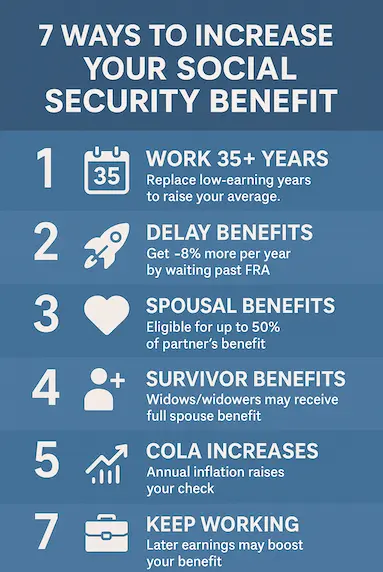
Image generated with AI assistance from ChatGPT & DALL·E, and is for educational purposes only. It does not reflect official SSA content
How to Increase Your Social Security Before You Claim
1. Work at Least 35 Years
The SSA calculates your benefit using your 35 highest-earning years.
If you worked fewer than 35, zeros get added to your record, lowering your average.
Even working a few extra years later in life can replace zero or low-earning years, increasing your benefit.
2. Wait Until Full Retirement Age (FRA)
Claiming early, as soon as age 62, reduces your monthly check permanently.
Your FRA depends on your birth year (66–67 for most), and filing before then means up to a 30% reduction.
Example: A $1,000 monthly benefit becomes $700 if claimed at 62.
3. Delay Until Age 70
If you wait beyond your FRA, you earn delayed retirement credits; about 8% more per year until age 70.
That’s about 24% increase if you wait from age 67 to 70.
Waiting isn’t for everyone, but if you can, it’s a powerful way to lock in higher income for life. For a detailed comparison of break-even points and lifetime payouts, see When Should You Claim Social Security at 62, 67, or 70?
4. Consider Spousal Benefits
If you’re married, you might be eligible for up to 50% of your spouse’s full benefit, even if you never worked.
This can be helpful if one spouse had significantly lower lifetime earnings.
Note: Rules are more favorable for those born before January 2, 1954.
5. Don’t Overlook Survivor & Dependent Benefits
If your spouse passes away, you may be eligible to receive their full benefit if it’s larger than your own.
Children under age 18 (or disabled before 22) may also qualify for up to 50% of your full benefit.
The total family benefit is capped between 150% and 180% of your retirement benefit.
How to Increase Your Social Security After You Start Collecting
6. Watch for COLA Increases
Each year, the SSA adjusts benefits through a Cost-of-Living Adjustment (COLA) to help retirees keep pace with inflation. These annual increases happen automatically, but they can make a meaningful difference over time:
- 2022: 8.7%
- 2023: 3.2%
- 2024: 2.5%
Source: SSA Cost-Of-Living Adjustments
These boosts happen automatically, but they can make a major difference over time.
How COLA Can Increase Your Social Security Benefit Over Time
Even modest COLA increases can have a major cumulative impact on your monthly benefit. Let's look at an example:
Starting Monthly Benefit: $2,000
Using actual COLA rates from 2015–2024:
| Year | COLA (%) | Monthly Benefit |
|---|---|---|
| 2015 | 0.0% | $2,000.00 |
| 2016 | 0.3% | $2,006.00 |
| 2017 | 2.0% | $2,046.12 |
| 2018 | 2.8% | $2,103.41 |
| 2019 | 1.6% | $2,137.07 |
| 2020 | 1.3% | $2,164.85 |
| 2021 | 5.9% | $2,292.57 |
| 2022 | 8.7% | $2,492.03 |
| 2023 | 3.2% | $2,571.77 |
| 2024 | 2.5% | $2,636.07 |
Total Increase (2015–2024):
From $2,000 to $2,636.07 → a 31.8% increase over 10 years
That’s $7,632.80 per year in benefits, from COLA.
Even if you’re not working or earning more, COLA keeps growing your check, especially important during times of inflation.
Source: SSA COLA History
Review key 2025 tax changes that could affect your retirement income.
Be Smart About Social Security Taxes
Up to 85% of your Social Security benefits may be subject to federal income tax, depending on your combined income and filing status. Note: California does not tax Social Security benefits at the state level, though the federal thresholds discussed below still apply.
The IRS defines combined income as:
Your adjusted gross income (AGI) : Nontaxable interest + ½ of your Social Security benefits
Here’s how the thresholds work:
- Single filers:
- Benefits may be taxed if income is more than $25,000
- Up to 50% taxable: $25,000–$34,000
- Up to 85% taxable: Over $34,000
- Married filing jointly:
- Benefits may be taxed if income is more than $32,000
- Up to 50% taxable: $32,000–$44,000
- Up to 85% taxable: Over $44,000
- Married filing separately:
- Benefits may be taxed if income is more than $25,000
- Up to 50% taxable: $25,000–$34,000
- Up to 85% taxable: Over $34,000
- If you lived with your spouse at any point during the year, up to 85% is taxable, regardless of income.
Learn how tax-efficient withdrawals makes difference in retirement.
Tax-Efficient Strategies
To reduce the impact of Social Security taxation, consider:
- Roth IRA conversions by paying tax now to potentially lower future taxable income
- Tax-loss harvesting in brokerage accounts
- Managing withdrawals from retirement accounts to stay below key thresholds
Coordinating these strategies with your overall retirement income plan is key. Learn more in Tax-Efficient Retirement Withdrawals: how to sequence withdrawals from multiple account types to minimize lifetime taxes.
Sources:
- IRS – Social Security Benefits May Be Taxable (Tax Tip 2022-22)
- SSA – Must I Pay Taxes on My Social Security Benefits?
7. Keep Working (Strategically)
Even after claiming, you can increase your benefit by continuing to work, especially if you're replacing earlier low-earning years.
Here’s the maximum Social Security benefit available in 2025 based on your claiming age under current law as of the date this article was written:
- Age 62 (early filing): $2,831/month
- Full Retirement Age (66–67): $4,018/month
- Age 70 (max delayed benefit): $5,108/month
(Source: Social Security Administration)
Social Security Benefit by Claiming Age
| Claiming Age | Max Monthly Benefit (2025) | Notes |
|---|---|---|
| Age 62 | $2,831 | ~30% reduction from FRA |
| Full Retirement Age (66–67) | $4,018 | Full benefit |
| Age 70 | $5,108 | ~24–32% increase via delayed credits |
What Most People Get Wrong About Social Security
Despite being one of the most important retirement benefits, Social Security is sometimes misunderstood. Here are some myths, and the facts that can help you make smarter decisions:
“Social Security is going bankrupt”
- The trust fund may be depleted around 2032, but benefits won’t stop.
- Even without reforms, about 78% of scheduled benefits will still be paid from ongoing payroll taxes.
Source: A Summary of the 2026 Annual Reports – ssa.gov
“You should claim as early as possible”
- Claiming at age 62 locks in a permanent reduction of up to 30%.
- Waiting until your full retirement age (FRA), or up to age 70, can significantly increase your lifetime benefit.
- Break-even point is typically between ages 78–80, depending on longevity.
“Your benefit amount never changes”
- After claiming, your benefit can still grow due to:
- Annual Cost-of-Living Adjustments (COLAs)
- Higher earnings replacing lower-earning years
- Switching to a higher spousal or survivor benefit
“Social Security will cover all your retirement needs”
- The average monthly benefit in 2025 is $1,976 under current law as of the date this article was written, while the average cost of independent living exceeds $3,000/month (see sources above in this blog).
- Social Security was designed to supplement, not replace, other retirement income sources like savings or pensions.
The Bottom Line
Social Security was never meant to be your only income, but maximizing it can go a long way toward a more secure retirement.
Whether you’re still planning or already collecting, these strategies can help boost what you receive, and in today’s economic climate, every dollar counts.
Need Help Planning?
Estimate your Social Security and retirement income using the
Official SSA Retirement Estimator
Further Reading
- How Work Affects Your Benefits – SSARead article →
- COLA Adjustments – SSARead article →
- Retirement Age Calculator – SSARead article →
Need Help Navigating Social Security?
As a fiduciary financial planner, I help clients integrate their Social Security decisions into their overall retirement strategy with taxes, investments, and long-term goals.
Start here to explore personalized retirement planning.