
When planning for retirement, one of the most important choices you may face is: ”When should I start claiming Social Security?”
This decision impacts your lifetime income, tax strategy, and even your spouse’s benefits. Whether you’re weighing Social Security at 62 vs 70, wondering whether to claim Social Security at 67 or 70, or comparing Social Security at 66 vs 70, this guide breaks down the key considerations and the pros and cons of claiming at 62, 67, or 70.
Social Security Basics
Before diving into the pros and cons, it’s important to understand the basics of how Social Security works. This foundation helps clarify the advantages and drawbacks of each claiming age.
How Your Benefits Are Calculated
Social Security calculates your primary insurance amount (PIA) based on your 35 highest-earning years, adjusted for inflation.
Your PIA serves as the baseline monthly Social Security benefit you receive if you start claiming at your full retirement age.
For more ways to increase your Social Security benefits, consider strategies that complement your retirement portfolio.
Your Full Retirement Age (FRA)
Your full retirement age is typically 66–67, depending on your birth year. This is the age at which you receive 100% of your PIA.
Full retirement age has shifted over time as Social Security rules and life expectancy have changed.
California note: California does not tax Social Security benefits at the state level. However, when computing federal taxable income on an IRA withdrawal, the calculation remains the same regardless of state. If you're in California, you benefit from state-level exemptions while still managing federal taxation of your Social Security benefits based on combined income and the Social Security tax torpedo effect (see below).
Your Early or Delayed Claiming Options
You can start claiming Social Security as early as age 62, but the trade-off is a smaller monthly benefit. On average, claiming at 62 results in approximately 70% of the full benefit for the rest of your retirement.
If you wait until full retirement age (66–67 depending on your birth year), you receive 100% of your benefit.
Delaying even longer increases your monthly check through “delayed retirement credits.” For most people born after 1943, this means approximately an 8% increase per year, up until age 70. After 70, there is no additional benefit to waiting.
For details and exact numbers by birth year, check the SSA reduction chart and the SSA delay calculator.
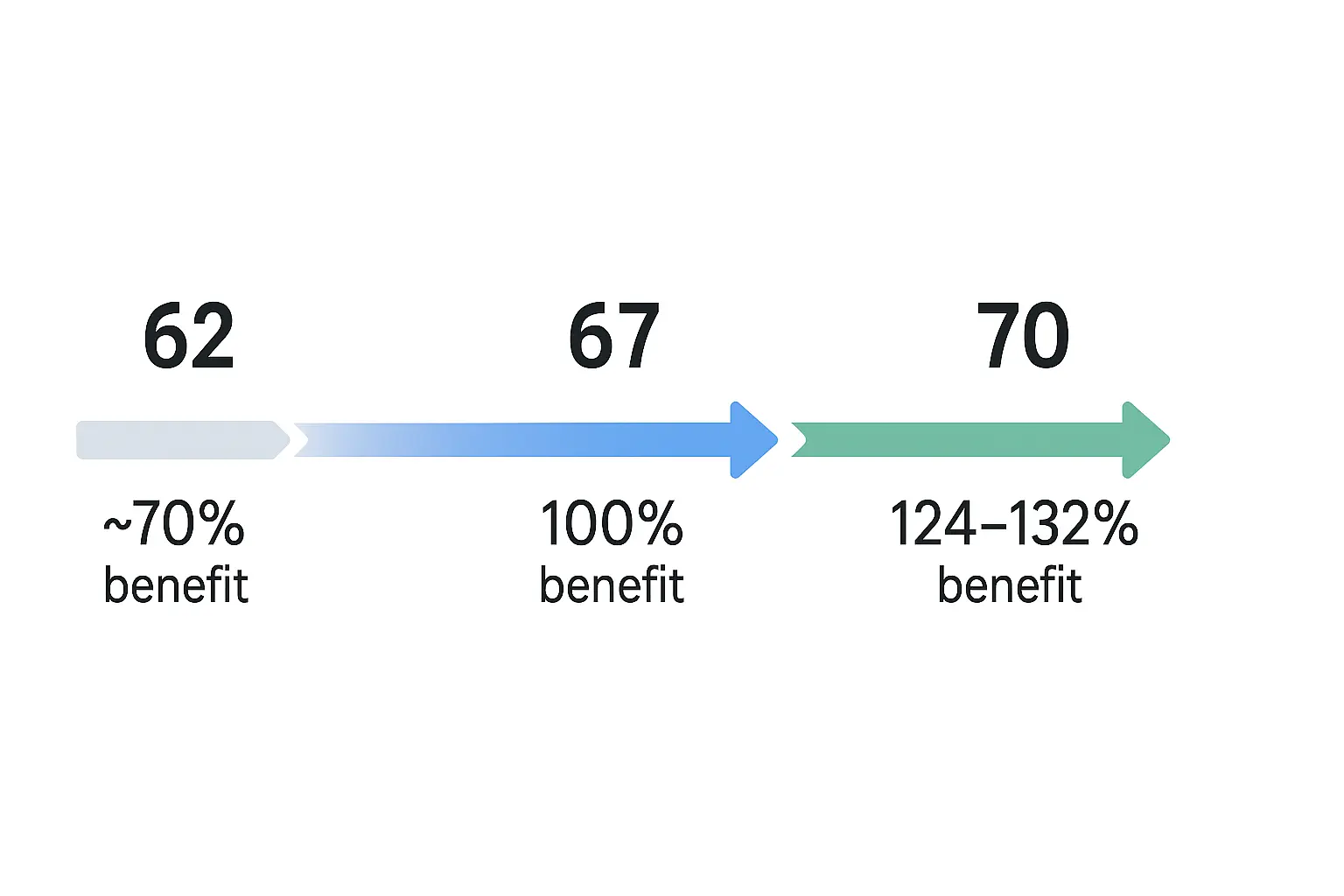
Image generated with AI assistance from OpenAI for educational purposes only.
Should I Take Social Security at 62? Pros & Cons
Downsides
- Lower monthly benefits: If you claim early, you may lock in a permanent reduction. For example, claiming at 62 may reduce your benefit to about 70% of your PIA.
- Working while claiming early: If you claim Social Security before FRA and continue working, some of your benefits may be temporarily withheld if your income exceeds certain limits.
- Under full retirement age for the year: In 2026, you can earn up to $23,400 without reductions. Above that, Social Security withholds $1 for every $2 you earn over the limit.
- Year you reach full retirement age: Only earnings before your birthday month are counted. In 2026, the limit is $62,160. Benefits are withheld $1 for every $3 above this limit.
- After reaching full retirement age: No limits. Your earnings do not affect your full benefits.
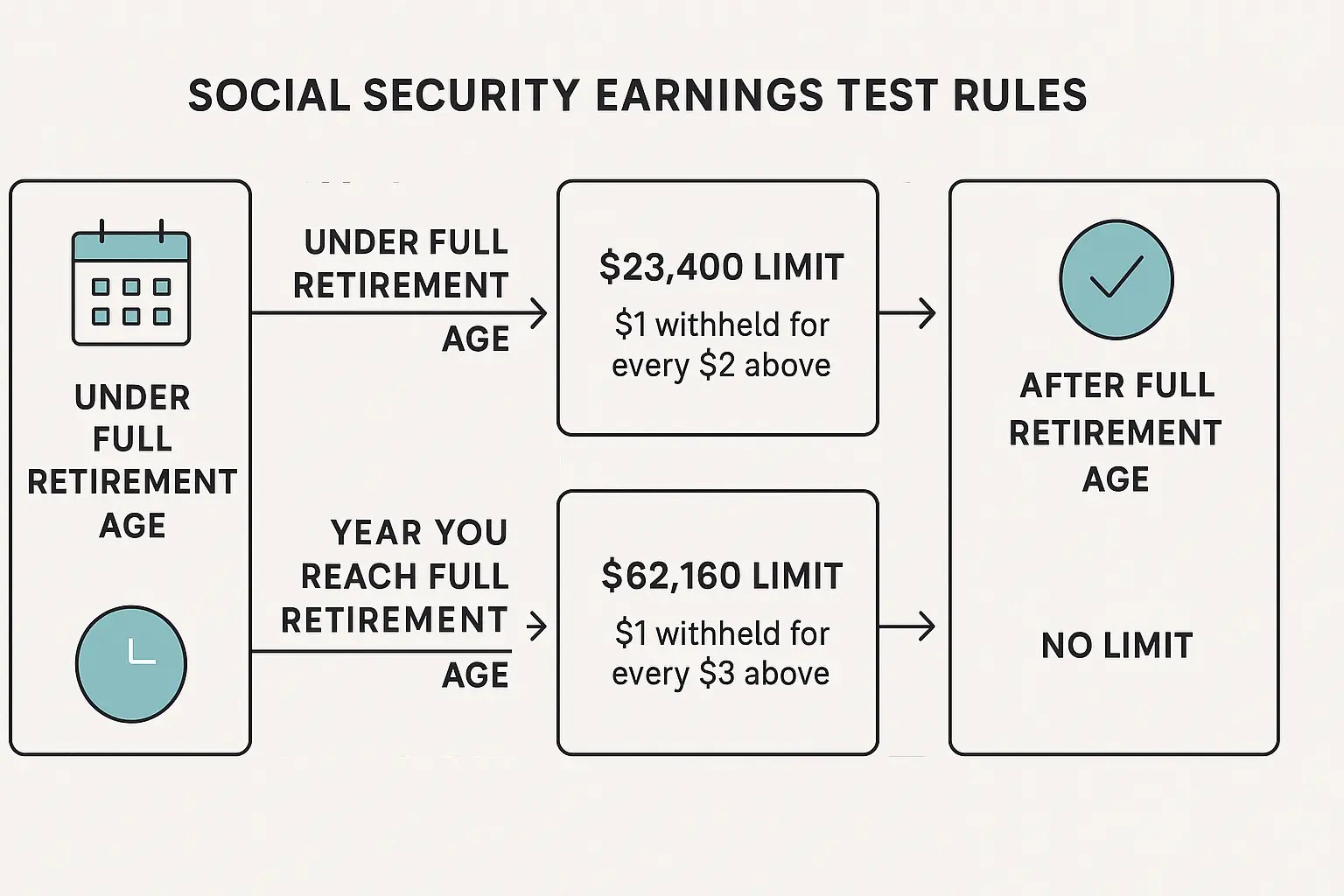
Image generated with AI assistance from OpenAI for educational purposes only.
It’s also important to understand how Social Security is taxed in California and federally to make the most of your benefits.
According to the Social Security Administration, withheld benefits are credited back when you reach FRA, so you don’t permanently lose them.
- Impact on your survivor benefits: If you claim early, you may reduce the income available to your surviving spouse.
Potential Benefits
- Immediate cash flow: You may have income right away if needed.
- Portfolio flexibility: If you claim Social Security earlier, you may reduce the need to withdraw from your investments.
Coordinating your Social Security with other assets is easier with guidance from a Santa Rosa financial advisor who can build your retirement portfolio.
For more details, see the Social Security Administration guide on early retirement reductions.
Should I Take Social Security at 67? Pros & Cons at Full Retirement Age
Full retirement age (FRA) represents the middle ground between claiming early and delaying. For most people born in the early 1960s, FRA is 66–67. Claiming at FRA offers a balanced approach that many consider.
Potential Benefits
- 100% of your primary insurance amount: At FRA, you receive the full benefit calculated from your earnings record, with no reduction.
- No earnings test limits: Unlike early claimers, once you reach FRA, you can work without benefit reductions, regardless of your income.
- Reasonable deferral period: If you wait from 62 to 67, you gain a meaningful boost in lifetime benefits compared to claiming at 62, while requiring only a 5-year deferral (easier than waiting to 70).
- Tax planning flexibility: If you defer past FRA to age 70, you have five years of lower taxable income in early retirement, which can reduce your portfolio withdrawals and create opportunities for Roth conversions in lower-income years. This coordination may help you manage the Social Security tax torpedo effect when other income sources are included.
- Spousal benefits available: Your spouse may claim up to 50% of your FRA benefit if they have also reached FRA.
Potential Downsides
- Smaller increase than waiting to 70: If you delay from 67 to 70, you may forgo a significant benefit increase (about 24% more per month at 70 vs 67).
- Higher portfolio withdrawal risk: If you wait from 62 to 67 to receive full benefits, you may have drawn substantially from your investment accounts, which can create sequence-of-returns risk.
- Breakeven analysis: If you claim at 67, you break even with an early claimer (age 62) around age 80. After that point, waiting could have generated more lifetime income.
Your Break-Even Analysis: 62 vs 67 vs 70
Understanding break-even ages can help you evaluate the cumulative lifetime benefit of each claiming strategy. The analysis below is illustrative and reflects simplified assumptions.
Important disclaimer: This break-even analysis does not account for:
- Investment returns on your portfolio assets during the deferral period
- Sequence-of-returns risk (the timing of your withdrawals matters)
- Tax efficiency of your withdrawal strategies
- Inflation and cost-of-living adjustments (COLA) beyond the initial benefit amount
- Your spouse's circumstances, health, or longevity
- Your other retirement income sources (pensions, rental income, etc.)
For a personalized analysis, consider working with a financial advisor who can model your specific situation including all your income sources, tax efficiency, and longevity expectations.
Example scenario: Suppose you have a primary insurance amount (PIA) of $3,000/month (illustrative):
- If you claim at 62: You receive ~70% of PIA = $2,100/month
- By age 80, cumulative benefit: ~$478,000
- By age 85, cumulative benefit: ~$613,000
- If you claim at 67 (FRA): You receive 100% of PIA = $3,000/month
- By age 80, cumulative benefit: ~$468,000
- By age 85, cumulative benefit: ~$720,000
- Breakeven vs age 62: approximately age 80
- If you claim at 70: You receive ~124% of PIA = $3,720/month
- By age 80, cumulative benefit: ~$446,000
- By age 85, cumulative benefit: ~$805,000
- Breakeven vs age 67: approximately age 82–83
- Breakeven vs age 62: approximately age 80–81
These figures are estimates and do not account for inflation, cost-of-living adjustments (COLA), or mortality risk. Your actual Social Security amounts will vary based on your individual earnings history and the year of claiming.
Key insight: If you expect to live past age 80–82, you typically benefit from waiting past 62. If you expect longevity into your mid-80s and beyond, you may see significant cumulative gains from waiting until 70.
Should I Take Social Security at 70? Pros & Cons of Waiting
Potential Benefits
- Maximized Social Security: Your monthly benefits may increase up to 24% higher than your full retirement age.
- Higher income floor: You create a stable income in later years, reducing your longevity risk.
- Supports tax strategies: If you defer Social Security, you may enable more effective Roth conversions and lower taxable income in early retirement.
- Protection for your spouse: If you're married, your surviving spouse may benefit from the higher income floor.
Working with an independent, fiduciary, fee-only financial advisor may help ensure your Social Security strategy aligns with your long-term retirement plan.
Potential Downsides
- Delayed gratification: You must wait longer to access your benefits, which may require drawing from other sources.
- Uncertainty of lifespan: If you pass away before collecting, you may forfeit the deferred benefits.
- Opportunity cost: If you delay, you may need to use your investment portfolio assets sooner, potentially reducing your compounding potential.
Should I Take Social Security at 62 vs 67?
If you're deciding between claiming at 62 versus 67, the key trade-off is immediate income versus higher lifetime benefit.
- Choose 62 if: You need cash flow now, expect average or shorter life expectancy, or want to access benefits before full retirement age.
- Choose 67 if: You can wait 5 years, want the full benefit (100% PIA), and expect to live past age 80.
Break-even point: You break even around age 80. After that, waiting until 67 generates more cumulative lifetime income.
Should I Take Social Security at 67 vs 70?
If you're deciding between 67 and 70, this is about delaying for higher income versus claiming at full retirement age.
- Choose 67 if: You want full benefits without waiting longer, need cash flow in your mid-60s, or have average longevity expectations.
- Choose 70 if: You can defer 3 more years, want maximum monthly income (24% more than age 67), and expect longevity into your 80s or beyond.
Break-even point: Waiting until 70 breaks even with age 67 around age 82–83. After that, the higher benefit accumulates significantly.
Should I Take Social Security at 62 vs 70?
If you're comparing the earliest and latest claiming ages, you're evaluating the full range of trade-offs.
- Choose 62 if: You prioritize immediate access to benefits and don't expect to live significantly past age 80.
- Choose 70 if: You prioritize maximum lifetime income, can sustain your lifestyle without Social Security for 8 years, and expect longevity into your 80s or beyond.
Break-even point: The break-even age is approximately 80–81. If you live past that, waiting until 70 generates substantially more cumulative lifetime income.
Key insight: The longer you expect to live, the more compelling the case for waiting past 62.
How Your Spousal and Survivor Benefits Work
Your Social Security claiming age affects not only your lifetime income but also the benefits available to your spouse and survivors. This multi-person dimension of Social Security planning may be overlooked but can significantly affect your household retirement income.
Your Spousal Benefits
Your spouse (or ex-spouse, under certain conditions) may claim benefits based on your Social Security record. The spousal benefit is typically up to 50% of your primary insurance amount (PIA) if your spouse has reached full retirement age.
Key dynamics:
- If you delay Social Security to age 70, your higher benefit may support a higher spousal benefit (still capped at 50% of your FRA amount, not your age-70 amount).
- If your spouse is approaching FRA and you have not yet claimed, you may want to file for benefits (even if reducing by early filing) to allow your spouse to begin collecting on your record.
- Your spouse's decision to claim early or delay is independent of your timing but is affected by your benefit amount.
How Your Survivor Benefits Work
If you pass away before claiming Social Security, your family's survivor benefits depend on your earnings record. Delaying Social Security increases the survivor protection you leave behind.
Who can receive your survivor benefits (per Social Security Administration):
- Your surviving spouse: age 60 or older (or any age if caring for a child under 16)
- Your unmarried children: under age 19 (or up to age 23 if enrolled in college full-time)
- Your dependent parents: age 62 or older
How your claiming age affects survivors:
- If you wait until age 70 to claim, you lock in a higher benefit amount for your survivors. The survivor's benefit is based on your benefit at the time of your death, not what you would have received if still living.
- If you claim early, your survivor protection is reduced because the survivor benefit is proportionally reduced along with your reduced benefit.
Coordinated Planning Example
Scenario: You and your spouse are both near FRA. You (the higher lifetime earner) are considering whether to delay Social Security to age 70. Your spouse may still be working or may depend on your household Social Security income.
- If you wait to 70: You secure a higher personal benefit, a higher spouse benefit (when your spouse claims), and higher survivor protection if you pass away. However, your household may need to rely on your spouse's income or portfolio withdrawals during the gap years until 70.
- If you claim at 67: You begin receiving your FRA benefit immediately, your spouse can claim spousal benefits, and your household cash flow begins sooner. The tradeoff is lower lifetime income for your household if you both live into your 80s.
The optimal strategy depends on your household health expectations, other retirement income sources, and whether your portfolio can sustain the waiting period. This coordination is where personalized financial planning becomes valuable: it's not a decision you can optimize alone.
The Bottom Line
There is no one-size-fits-all answer for you.
Age 62 may be appropriate if you need immediate cash flow or if you expect a shorter life expectancy.
Age 67 (Your Full Retirement Age) provides a balanced approach with full benefits at a moderate deferral, suitable if you have average longevity expectations and want to reduce your portfolio drawdowns in early retirement.
Age 70 may maximize your monthly benefits and longevity protection but requires delayed gratification and portfolio discipline during the deferral years.
Your right choice depends on:
- Your health and life expectancy: the primary driver of your break-even analysis
- Your spouse and survivor considerations: your claiming age affects your household and family security
- Your cash flow needs: whether your portfolio assets can sustain the deferral period
- Tax efficiency: whether deferring your Social Security enables lower taxable income, Roth conversions, or mitigation of the Social Security tax torpedo
- Your overall retirement plan: coordinating your Social Security with your investments, RMDs, and tax-efficient withdrawal sequencing
Optimizing this multi-variable decision is difficult in isolation. Working with a fiduciary advisor to coordinate your Social Security timing with your investments, taxes, and retirement income planning typically reveals strategies you might miss on your own.
Image generated with AI assistance from OpenAI for educational purposes only.
Key Takeaways
- You can claim Social Security any age from 62 to 70; this guide focuses on the three most common claiming ages (62, 67, and 70), each with distinct trade-offs.
- If you claim early (age 62), your monthly benefits are reduced; if you delay, they increase through delayed retirement credits (approximately 8% per year until age 70).
- Break-even analysis shows that if you wait until 67, you typically recover early claiming deficits by your early 80s, and if you wait until 70, by your early 80s (depending on your life expectancy).
- Your Full Retirement Age (67) provides a balanced approach with full benefits and no earnings-test penalties, suitable if you have average longevity expectations.
- If you delay claiming (waiting until 70), you may improve your portfolio flexibility and support tax-efficient strategies, including Social Security tax torpedo mitigation and Roth conversions.
- Your spousal and survivor benefits are affected by your claiming age and should be considered in your household planning.
- Your health, life expectancy, spouse considerations, cash flow needs, and tax efficiency are central to your claiming decision.
Avoid common pitfalls by reviewing costly tax mistakes retirees make related to claiming Social Security and withdrawals.
Coordinate your Social Security with your investment accounts for tax-efficient withdrawals in retirement.
If you're seeking professional guidance, learn how to start working with a trusted financial advisor to make confident Social Security claiming decisions.
Explore available financial planning services for a comprehensive approach to retirement income planning and Social Security coordination.
Learn more about what to look for in a financial advisor when optimizing your Social Security timing and retirement strategy.
For a deeper dive into how your Social Security claiming interacts with federal taxation, read the Social Security tax torpedo article to see how your claiming age affects your effective tax rates when combined with your other retirement income sources.