
You probably know that personal finance matters. But do you know the 10 essentials that actually move you toward financial independence?
Most people understand that managing money wisely leads to a less stressful life. But without a clear framework, even good intentions can scatter across competing priorities. This guide walks through the 10 fundamentals of personal finance: budgeting, saving, investing, taxes, insurance, and retirement planning. Whether you are just starting out in your career, raising a family, or planning for retirement, these principles apply to your situation. By learning to protect what you have, grow your wealth, and manage your resources with intention, you can build control, clarity, and confidence in your financial life. Each section covers one essential area with actionable steps you can implement today.
The Three Pillars of Personal Finance
| Pillar | What It Covers |
|---|---|
| Protect | Insurance, emergency fund, estate plan |
| Grow | Investing, retirement, career income |
| Manage | Budget, debt, taxes |
Think of personal finance as three pillars: Protect, Grow, and Manage. Each supports your financial well-being in a unique way.
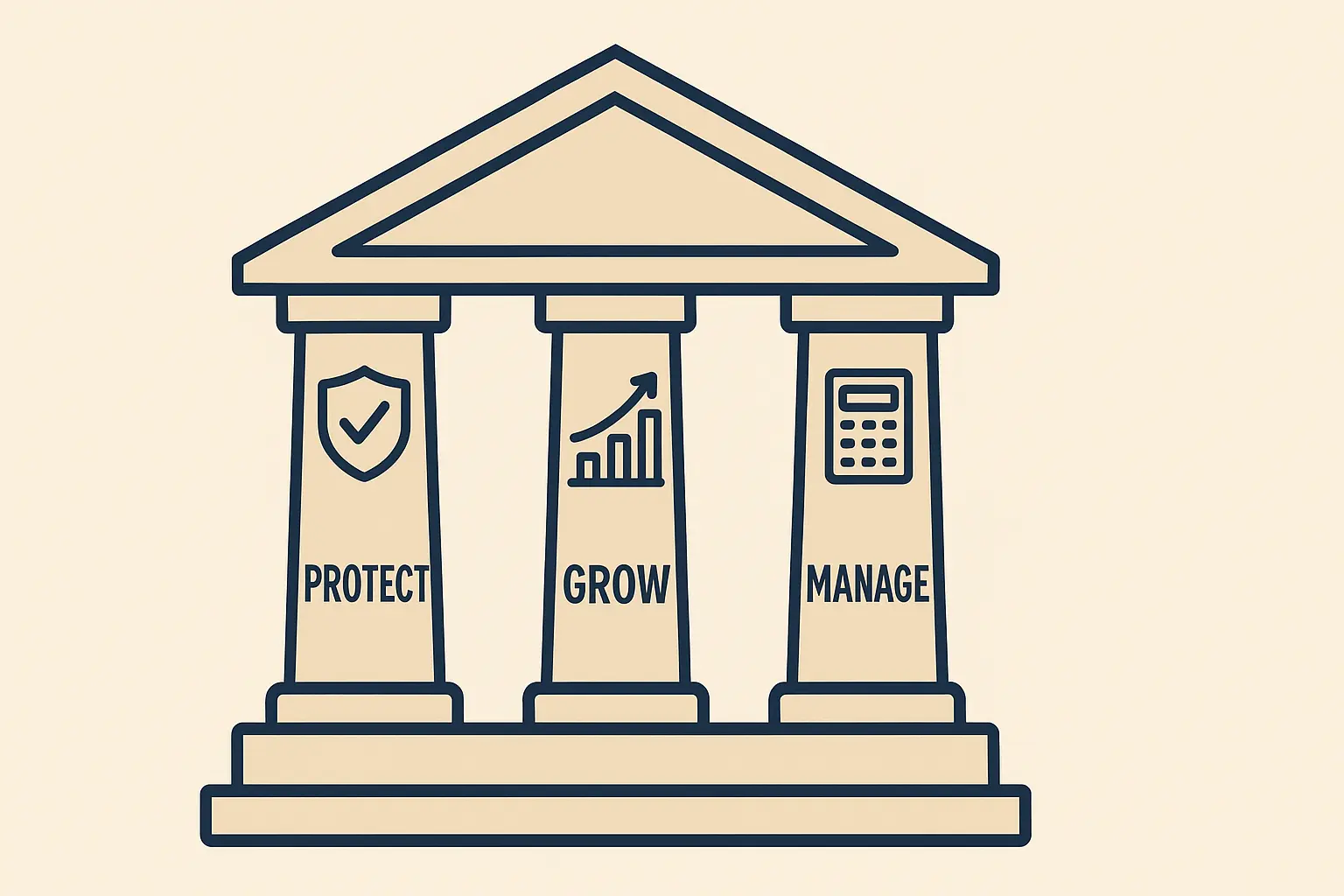
Image generated with AI assistance from OpenAI for educational purposes only.
1. What Is Budgeting and Why Does It Matter?
- Live below your means. Spending less than you earn creates financial breathing room and allows you to save and invest for future goals. This doesn’t mean cutting out all fun—it’s about intentional choices.
- Use a budget system. A system helps you stay disciplined. Options include the 50/30/20 rule (50% needs, 30% wants, 20% savings), zero-based budgeting, or envelope systems. Apps like Monarch, YNAB, or even a simple spreadsheet can help.
- Track income and expenses. Awareness is the first step to control. By reviewing your cash flow monthly, you can spot overspending trends and redirect money toward your priorities.
- Pro Tip: Automate your savings by setting up direct deposits into a savings or investment account—this makes saving effortless.
- Advanced Insight: Track not just spending, but spending trends. A small recurring subscription might look harmless, but over 12 months it can significantly reduce savings potential.
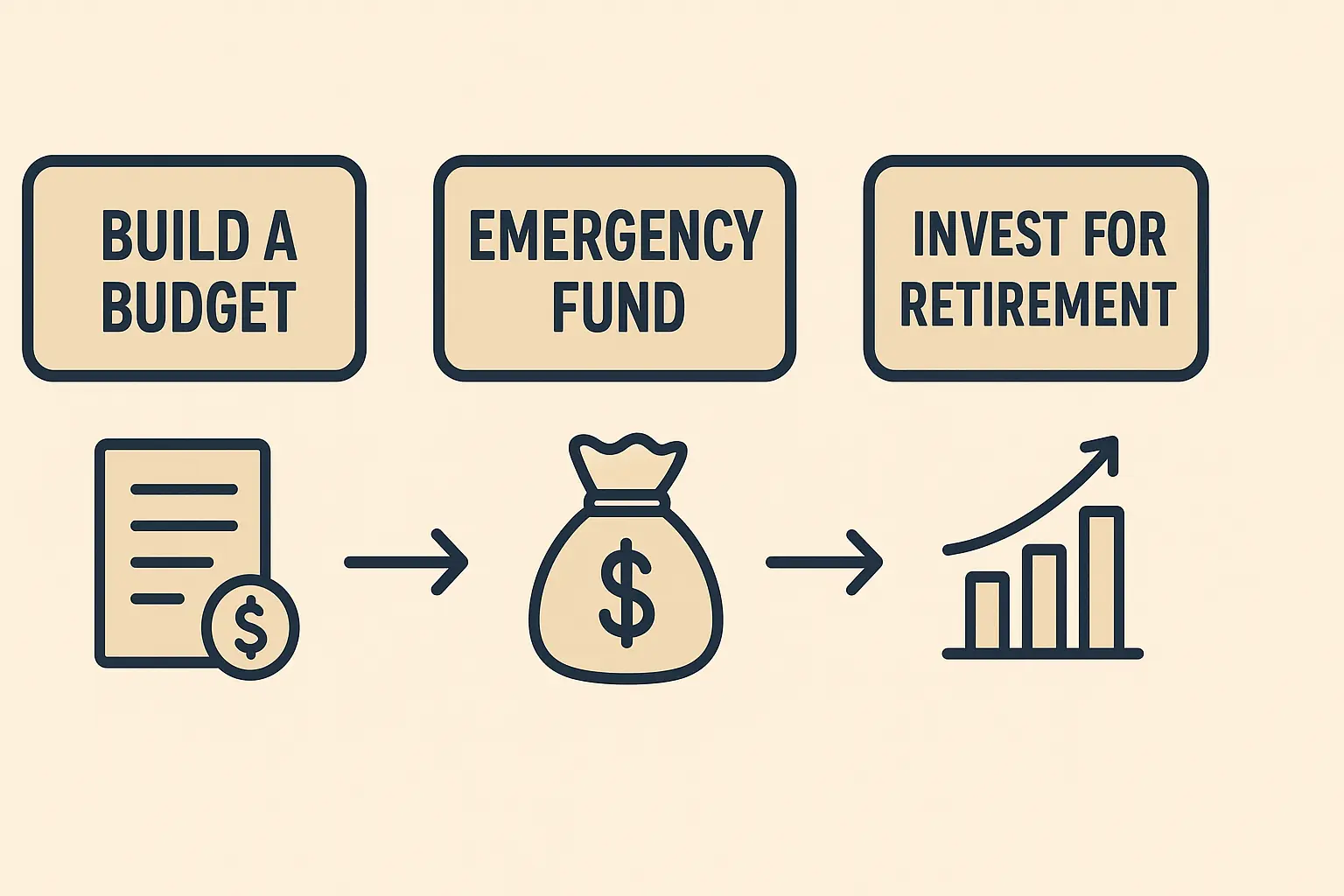
Image generated with AI assistance from OpenAI for educational purposes only.
2. Why Do You Need an Emergency Fund?
- Save 3–6 months of essential expenses. If your job is unstable or you’re self-employed, aim for the higher.
- Keep it liquid. Emergency funds are not for investing. A high-yield savings account, money market fund, or even a simple checking account works best.
- Why it matters: Life is unpredictable. Whether it’s a job loss, medical bill, or car repair, having cash on hand keeps you from going into debt during tough times.
- Pro Tip: Start with a micro-goal like $1,000. Reaching this faster gives you momentum to continue building.
- Advanced Insight: Consider tiered emergency funds—keep 1 month in checking for ultra-liquidity, and the rest in a high-yield savings or money market account.
3. How Do You Manage Debt Effectively?
- Prioritize high-interest debt. Credit card debt can quickly spiral, often carrying rates above 20%. Tackling this first saves you the most money.
- Choose a strategy:
- Avalanche: Pay off highest interest first. Saves money long-term.
- Snowball: Pay smallest balance first. Builds momentum and confidence.
- Borrow wisely. Debt isn’t always bad—mortgages, student loans, or business loans can be investments in your future. The key is ensuring the debt aligns with long-term goals and remains manageable.
- Pro Tip: Call lenders to negotiate lower interest rates or transfer balances to a 0% introductory APR card if possible.
- Advanced Insight: Tracking your debt-to-income ratio (DTI) helps you understand your borrowing capacity and is a key metric lenders look at when approving loans.
4. How Does Credit Health Affect Your Financial Life?
- Monitor your credit score. Free resources like AnnualCreditReport.com let you check your report once a year. Tools like Credit Karma give ongoing monitoring.
- Pay bills on time. Payment history makes up ~35% of your score—the single biggest factor.
- Manage credit utilization. Try to keep your balances below 30% of your available credit. The lower, the better. A strong credit score helps you qualify for lower interest rates on mortgages, car loans, and even impacts insurance premiums.
- Pro Tip: Set calendar reminders for credit card due dates to avoid missed payments—many issuers let you pick your due date for convenience.
- Advanced Insight: A mix of credit types (credit cards, installment loans, mortgage) boosts your score more than relying on one type of credit alone.
5. What Insurance Do You Really Need?
- Health, life, liability, and disability insurance. These cover the biggest risks—your health and your ability to earn an income.
- Auto, home, or renter’s insurance. Protects your property and shields you from liability.
- Why it matters: One accident or illness can wipe out years of savings. Insurance ensures your financial plan stays on track even when life throws a curveball.
- If you’re not wealthy enough to self-insure, proper insurance coverage is essential. Over time, as your assets grow, you may choose to self-insure for smaller risks—but until then, insurance acts as your financial safety net.
- Pro Tip: Shop insurance policies every 2–3 years. Rates and coverage change, and loyalty doesn’t always mean savings.
- Advanced Insight: If you’re not wealthy enough to self-insure, insurance is non-negotiable. But as your net worth grows, consider higher deductibles to lower premiums and self-insure for smaller risks.
References to insurance are for general educational purposes only. Trusted Path Wealth Management, LLC does not sell insurance products or receive commissions. For specific insurance needs, please consult a licensed insurance professional.
6. How Should You Save for Retirement?
- Start early. Thanks to compounding, even small amounts invested in your 20s can grow significantly by retirement.
- Contribute to retirement accounts. Max out tax-advantaged accounts like 401(k)s, Traditional IRAs, and Roth IRAs.
- Take advantage of employer matches. If your employer offers a match, contribute enough to get the full benefit—it’s essentially free money.
- Example: Saving $200/month at age 25 can grow to over $400,000 by age 65 (assuming 7% returns). Starting at 35 instead would result in less than half that amount.
(A hypothetical example for illustrative purposes only, not a guarantee of results. Any projections or examples are hypothetical and for illustrative purposes only. They do not represent actual results and are not guarantees of future outcomes.) - Pro Tip: Increase contributions by 1% annually—most people don’t notice the difference in their paycheck, but over time it massively grows your nest egg.
- Advanced Insight: Consider Roth conversions in low-income years to lock in tax-free growth, especially if you expect to be in a higher tax bracket later.
7. How Do You Build a Long-Term Investment Strategy?
- Think long-term. Don’t panic over daily market swings. Investing works best when you stay the course.
- Diversify. Spread your money across asset classes (stocks, bonds, real estate) and geographies to reduce risk.
- Keep costs low. High fees eat away at returns. Index funds and ETFs offer diversification with minimal expenses.
- Pro Tip: Automate investments with dollar-cost averaging (DCA). Investing a fixed amount monthly reduces the risk of poor market timing.
- Advanced Insight: Beyond diversification, asset location matters—place tax-efficient investments in taxable accounts and tax-inefficient ones (like bonds) in retirement accounts.
8. How Can You Minimize Taxes on Your Income?
- Understand taxation. Wages, dividends, capital gains, and retirement withdrawals are taxed differently. Knowing this helps you plan better.
- Use tax-advantaged accounts. Accounts like 401(k)s, Roth IRAs, and HSAs not only grow your money but may reduce your taxable income.
- Plan for efficiency. Use deductions (mortgage interest, charitable giving) and credits (child tax credit, education credits) to lower your bill.
- Retirement strategy: Be mindful of when and how you withdraw funds to minimize lifetime taxes.
- Pro Tip: Keep receipts for charitable donations, medical expenses, and job-related costs—you may qualify for deductions you might otherwise miss.
- Advanced Insight: Tax-loss harvesting allows you to sell underperforming investments to offset gains, reducing your tax bill while keeping your portfolio aligned. For a deeper dive on how to coordinate taxes across account types, see tax-efficient asset location.
9. Why Does Estate Planning Matter, and What Should You Do?
- Have a will and powers of attorney. A will ensures your wishes are followed, while powers of attorney appoint someone to act on your behalf if you can’t.
- Consider trusts. Useful for larger estates, blended families, or those who want to avoid probate.
- Update beneficiaries. Retirement accounts and life insurance policies pass directly to listed beneficiaries, regardless of what’s in your will—so keep them current.
- Why it matters: Estate planning isn’t just for the wealthy. It’s about making life easier for loved ones during difficult times.
- Pro Tip: Even if you’re young, create a simple will—it’s easier and cheaper than most people expect.
- Advanced Insight: Use “transfer on death” (TOD) or “payable on death” (POD) designations for accounts to pass assets directly, avoiding probate delays and fees.
Trusted Path Wealth Management, LLC does not provide legal services. For estate planning documents such as wills or trusts, please consult a qualified attorney.
10. How Should You Monitor and Adjust Your Financial Plan?
- Review regularly. Check your budget, investments, and goals at least annually, and after major life changes.
- Adjust as life changes. Marriage, children, new jobs, or relocations all affect your financial plan. Be flexible.
- Stay informed. Read books, listen to podcasts, or work with a trusted financial advisor. Money management isn’t static—it’s a lifelong journey.
- Mindset matters. Being open to learning helps you adapt and make better choices over time.
- Pro Tip: Schedule a personal “money day” once a year—review all accounts, update passwords, rebalance investments, and refresh goals.
- Advanced Insight: Stay adaptive—financial markets, laws, and opportunities evolve. Lifelong learning and flexibility are what separate average planners from those who achieve financial independence.
Go Deeper: Related Topics
- What Does It Mean to Be a Fee-Only Fiduciary Advisor?: Understand the difference between a fiduciary and other advisory relationships
- Common Retirement Mistakes: Avoid costly errors as you implement these basics
- A Step-by-Step Guide to Retirement Planning: How to integrate retirement savings with your overall plan
- Tax-Efficient Withdrawals in Retirement: Advanced coordination of taxes across account types
- How to Pay $0 Federal Taxes on $100,000 Retirement Income: A case study showing how these principles interact
- Should You Delay Student Loan Repayment: One personal finance decision that often requires trade-off analysis
The content on this site is provided for informational and educational purposes only and should not be construed as personalized financial advice.
Strategies discussed are general in nature and may not be appropriate for all individuals. Results will vary based on personal circumstances and market conditions.